
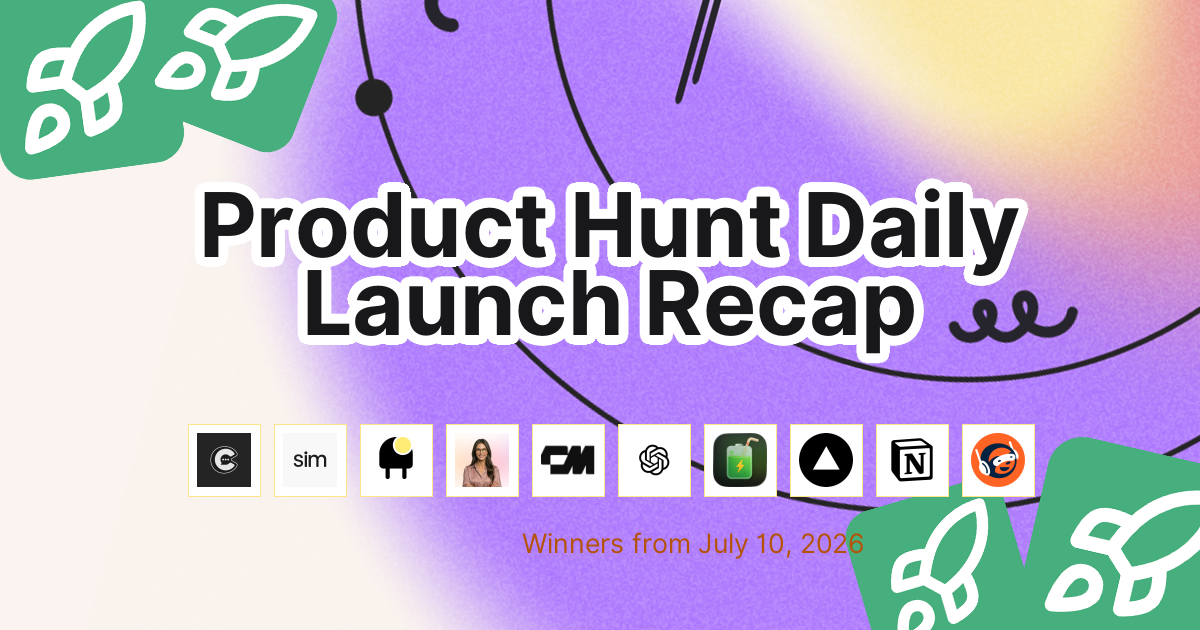
Product Hunt’s July 10 lineup had a clear pattern: the most compelling launches were not generic AI wrappers, but products that tried to sit directly inside an existing workflow. The day’s top-ranked launch, ChatCut, put AI inside video editing. Sim pushed on agent workflows. PlugThis turned natural language into browser extensions. Scarlett, ConnectMachine 2.0, and Ship OS all aimed at replacing scattered work with something more coordinated and more contextual.
That makes this a useful launch day to study. The strongest products did not just promise automation; they chose a specific environment where the pain is already familiar, then framed AI as the missing operator inside that environment. The votes and comments suggest that Product Hunt buyers responded to products with clear utility, a concrete use case, and enough ambition to feel like a real shift in how work gets done. Even the lower-ranked launches still leaned into that same theme: a battery app that simplifies Mac power management, a native desktop toolkit, and a content distribution layer for Claude.
1ChatCut
 ChatCut took the top spot with 681 votes and 91 comments, which tells you this was more than a curiosity. It positioned itself as an AI video editor that works inside ChatGPT, desktop, and web, but the real pitch is broader than the channel list. The product is trying to make video editing feel less like a specialized craft and more like a conversation with a capable assistant that can understand intent, structure, and timeline.
That positioning matters because it narrows the gap between “I know what I want” and “I know how to edit.” The description makes a point of saying users can make structural edits, refine cuts, add captions, B-roll, music, voiceover, motion graphics, stock footage, and AI-generated video, all while staying on a real editable timeline. The mention of XML export also suggests the team is speaking to serious creators rather than only casual users. In other words, ChatCut does not present itself as a toy assistant; it is trying to be a professional-grade editing layer that remains portable.
The vote count suggests the market is ready for AI that handles creative production without forcing users to abandon familiar workflow concepts. The comment count is healthy for a #1 launch, which usually means people were debating the practicality, the scope, or the implications of the product rather than just clicking through. What likely helped ChatCut stand out was the combination of breadth and restraint: broad enough to feel ambitious, but grounded enough in timeline editing to seem usable.
2Sim
 Sim landed at rank 2 with 620 votes and 107 comments, one of the strongest discussion numbers on the page. That is a good sign for a product in the infrastructure category, because infrastructure launches often need to explain themselves before they can win attention. Sim describes itself as an open-source workspace for building agentic workflows, with 1,000+ integrations and LLMs available for connecting agents and automations.
The positioning here is smart because it sits at the intersection of openness and scale. “Open-source workspace” signals control and extensibility, while “1,000+ integrations and LLMs” signals usefulness out of the box. For founders and builders, that combination matters: you want something flexible enough to adapt to your stack, but not so empty that you have to assemble everything yourself. Sim is clearly trying to be the place where AI agents stop being isolated experiments and start becoming systems.
Its high comment count suggests the Product Hunt audience saw it as more than another agent demo. People tend to respond when a launch speaks to real operational pain, and agent workflows are exactly where that pain is becoming visible for many teams. What likely helped Sim break out was the clarity of its promise. It does not simply say it has agents; it says it is the workspace where those agents and workflows connect to the tools and models people already use.
3PlugThis
 PlugThis came in at rank 3 with 533 votes and 111 comments, which is a strong signal that it sparked conversation as well as interest. Its pitch is unusually direct: create your own Chrome extensions by chatting with AI. The product frames itself around a very specific frustration, namely wanting a small workflow improvement that does not exist in the Chrome Web Store, and then being able to describe it in plain English instead of learning extension development from scratch.
That specificity is doing a lot of work. The product is not asking users to imagine a vague future where AI helps coding in general. It is saying that if you want something that saves 15 minutes a day, PlugThis can build it for you, and the code remains yours. It also goes further than generation by covering the annoying parts of shipping, including login, databases through Supabase, and the packaging work needed to publish to the store. That makes the product feel operational, not just aspirational.
The 111 comments likely reflect both excitement and skepticism, which is often what a good launch should generate. Chrome extensions are close enough to daily work that people can immediately picture the value, and close enough to software development that they also want to know where the boundaries are. What likely helped PlugThis stand out was the focus on a neglected but concrete category. Everyone else talks about building web apps. PlugThis chose extensions, which makes the promise feel narrower, sharper, and easier to understand.
4Scarlett.
 Scarlett. reached rank 4 with 408 votes and 59 comments, placing it in the middle of a very AI-heavy top ten. Its positioning is almost deliberately provocative: not another AI bot, but a real colleague to work alongside your team in Slack and iMessage. That is a stronger and more human way to describe the product than simply calling it an assistant, because it suggests an ongoing role rather than a one-off interaction.
This launch is part messaging and part category design. By talking about a co-worker instead of a bot, the team is trying to move the mental model away from chat and toward delegation. The description goes as far as saying it can give teams superpowers or even run a company on autopilot, which is obviously ambitious. But the launch’s place in the rankings suggests people were willing to engage with that ambition, at least enough to award it a solid vote count and active discussion.
The comment total is respectable without being overwhelming, which can indicate a product that people understand quickly. The appeal likely came from its promise to live where work already happens, inside team communication tools instead of a separate dashboard. That is a recurring theme on this day, and Scarlett fits it well. If it feels like a colleague, it is because it is being introduced in the same place colleagues already talk.
5ConnectMachine 2.0
 ConnectMachine 2.0 earned rank 5 with 392 votes and 43 comments. It presents itself as an AI digital business card that remembers everyone you meet, which is a memorable angle in a category that can otherwise feel interchangeable. Rather than treating business cards as a static contact exchange, the product turns them into a memory and follow-up system. It can create unlimited cards, scan paper cards, QR codes, or badges, and sync the people you meet into your CRM.
The launch page makes version 2.0 feel meaningful by listing a cluster of improvements that users likely asked for: a team plan with branded cards and admin controls, an AI note taker for transcripts and summaries, ShareBack for instant mutual exchange, follow-up reminders, and support for five languages. That “built from user requests” detail matters because it suggests the team is using real usage signals, not just roadmap imagination. It also helps explain why the product feels more developed than a simple contact-sharing gimmick.
Its votes and comments suggest that the market sees utility in reducing the friction of post-meeting follow-up. This is not the sort of product that wins by flash alone; it wins by being immediately easy to imagine in a sales or networking context. The lower comment count compared with some of the launches above may indicate the concept is clear enough that users did not need to debate it much. What likely helped ConnectMachine 2.0 stand out was the blend of polish, practical workflow, and a specific memory problem that many professionals recognize.
6GPT-5.6
 GPT-5.6 arrived at rank 6 with 302 votes and just 14 comments, which is a very different pattern from the products above. The launch is aimed at builders, not consumers, and it speaks in the language of model families and developer controls. OpenAI framed the release around three options in the API: Sol for the hardest agentic tasks, Terra for everyday workflows, and Luna for speed and cost efficiency. It also introduced Programmatic Tool Calling, Multi-agent beta support, and explicit prompt caching.
The low comment count is not surprising given the audience. Infrastructure launches like this often get votes from people who are tracking capability advances, but fewer public comments because the topic is technical rather than conversational. Still, the vote count shows there is plenty of interest in how model releases translate into new builder behavior. The mention of the upcoming OpenAI Day and the $10K API credit incentive for the top five launches adds a clear event-driven layer to the day, which likely helped attention on Product Hunt overall.
What likely helped GPT-5.6 stand out was the combination of choice and clarity. The model family is not being sold as one giant leap in vague intelligence; it is being split into practical roles that map to builder needs. That makes the launch feel productized in a way developers can reason about. Even without the comment volume of the consumer products, it sits firmly in the top ten because the audience understands that API releases can reshape what gets built next.
7Juicy – Mac Battery App
 Juicy – Mac Battery App took rank 7 with 227 votes and 30 comments. It is a good reminder that launch days are not only won by large AI ambitions. Juicy improves a very specific part of the desktop experience by replacing Apple’s basic battery warnings with custom alerts, screen glow, and sounds that are hard to miss. It also adds charge limiting, per-app energy insights, battery health tracking for iPhone and iPad, temperature tracking, and a themeable menu bar icon.
The product’s positioning is effective because it consolidates a cluster of utilities into one native app. Instead of asking users to stack multiple tools, it offers a single lightweight Swift app that covers battery management and monitoring in one place. That kind of bundle is easy to understand, and the “pay once, own forever” framing gives it a straightforward consumer software feel that contrasts with the subscription-heavy tone of much of the AI space.
Its vote and comment totals suggest a smaller but meaningful audience that values design, utility, and simplicity. The mention that Apple featured it twice as “Apps We Love” adds social proof without feeling overdone, and likely helped reassure people that this is a polished desktop product rather than a hobby project. What likely helped Juicy stand out was the fact that it solves an annoyance people have every day, in a way that feels native rather than bolted on.
8Native SDK

That clarity is important because desktop tooling often has to justify why it exists in a world where many apps are web-based. Native SDK is essentially arguing that if you care about beautiful native software, you should not have to settle for browser wrappers. The product is not trying to appeal to everyone; it is speaking directly to teams and developers who are already frustrated by desktop compromises and want a more principled stack.
The modest vote count and relatively low comments number fit the category. Developer tools usually need stronger product-market fit and more domain familiarity than consumer launches, so they tend to earn a narrower but more focused response on Product Hunt. What likely helped Native SDK make the top ten was the strength of the stance. The product knows exactly what it is against, which makes it easier for builders to decide whether they care.
9Ship OS by Notion
 Ship OS by Notion reached rank 9 with 155 votes and 9 comments, putting it near the lower end of the top ten but still clearly visible. Its pitch is that you can run the entire product development cycle in Notion, from customer feedback to a merged PR, with agents handling triage, routing, and summarization while the team handles judgment calls. That is a strong example of workflow-native AI: the agents are not the product, they are the operators that keep the system moving.
The positioning is especially interesting because it uses Notion as the home base for a full software delivery loop. That is a promise a lot of teams can picture immediately, even if they are unsure how much of the loop they would hand over to agents. The description carefully preserves human decision-making, which helps the product avoid the usual overreach associated with full automation language. It is not saying agents replace the team; it is saying agents handle the repetitive connective tissue.
The very small comment count suggests the audience may have seen the concept quickly and moved on, or that the launch appealed more to practitioners than to debaters. Either way, the vote total is enough to show that the idea resonated. What likely helped Ship OS by Notion stand out was its practical framing inside a familiar workspace, because founders already understand the burden of moving feedback, decisions, and engineering work across too many tools.
10StoryChief Connect
 StoryChief Connect closed the top ten at rank 10 with 141 votes and 13 comments. It positions itself as a way to publish content from Claude to your website and socials, but the broader message is about orchestration. The product gives Claude and marketing teams access to the tools, data, workflows, and publishing channels needed to run actual campaigns across a connected content calendar.
This launch stands out because it takes one of the most talked-about AI tools and places it in a real marketing operating system. Rather than treating Claude as a standalone writing aid, StoryChief Connect turns it into part of a distribution engine. That distinction matters for founders, because content creation is only valuable when it can move through planning, collaboration, scheduling, and publishing without breaking the workflow.
The vote count is modest, but the product’s placement in the top ten suggests a useful kind of relevance rather than mass-market spectacle. The launch reads like something a marketing team would adopt because it solves workflow fragmentation, not because it makes a dramatic promise. What likely helped it earn attention was that it connects a familiar AI assistant to the less glamorous but essential parts of execution, which is exactly where many AI products become useful.
What founders can learn from this launch day
The most obvious lesson from July 10 is that Product Hunt still rewards products that are specific about the job they do. The launches that climbed highest were not the ones with the broadest AI language. They were the ones that sat directly inside a real workflow, whether that was editing video, building browser extensions, managing agent workflows, or coordinating product work in Notion. When the product has a clear place in the user’s day, the pitch becomes easier to trust.
A second lesson is that positioning matters as much as capability. Several of these launches could have been described in flatter terms, but their makers chose sharper narratives: a co-worker instead of a bot, a memory system instead of a card, a workspace instead of a workflow tool. Those choices help users decide what category the product belongs in before they even understand every feature. That seems to matter a lot on a crowded launch day where many products share the same underlying technology.
Finally, this day showed that utility still travels well. The lower-ranked launches were not weaker because they lacked ambition; they were often more grounded. Juicy, Native SDK, and StoryChief Connect each solve a concrete problem for a concrete user. Even GPT-5.6, which is clearly the most platform-level release on the list, was framed in terms of practical model choices and developer behavior. For founders, the takeaway is simple: the products that earned attention today did not try to impress everyone at once. They identified one painful workflow, spoke plainly about it, and made the path from interest to understanding very short.
