
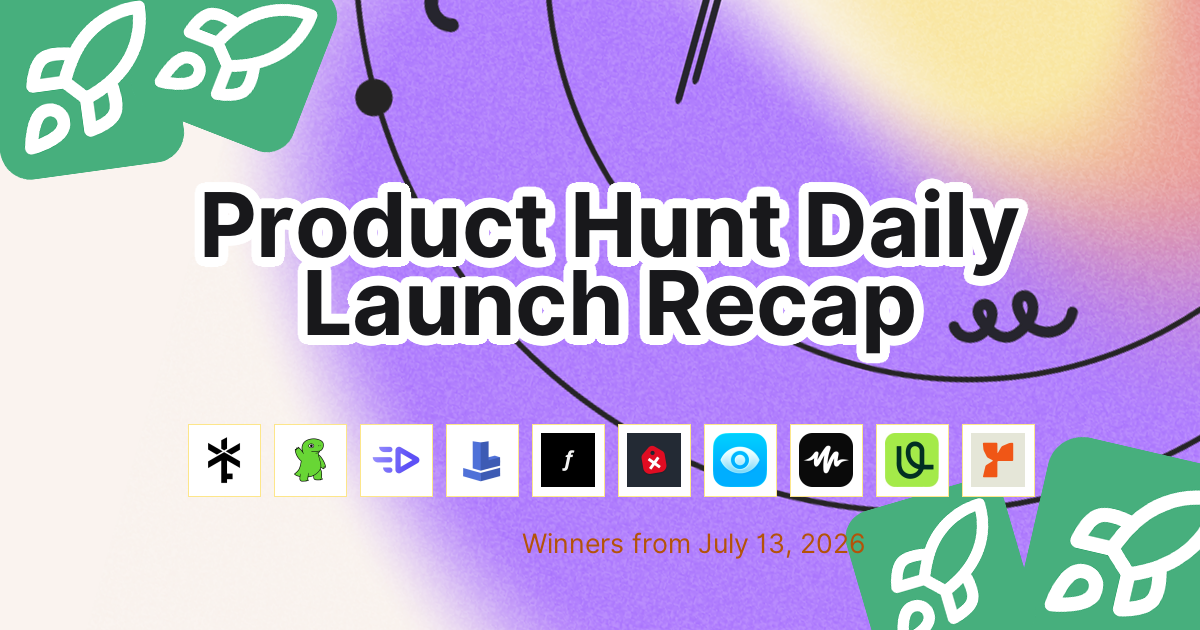
Product Hunt on July 13, 2026 felt like a very specific snapshot of where builders’ attention is going. The day was led by products that help agents do real work, keep that work private or local, and turn that work into something monetizable. There was also a quieter but telling thread running underneath it all: founders are no longer only shipping “AI features.” They are building the infrastructure, guardrails, and workflows around AI-native products.
What makes this launch day interesting is not just the volume of AI, but the different business problems people are trying to solve with it. Some teams are making agents more useful by giving them live data. Others are making them safer by keeping them on-device. A few are trying to make the economics work, whether that means charging agents directly, pricing usage properly, or showing value clearly enough that customers keep paying. For founders, this is a useful read on where the market has moved from demos to deployment.
1AgentKey
 AgentKey arrived at rank 1 with 662 votes and 121 comments, and that level of engagement fits the pitch almost perfectly. The product positions itself as a one-stop live data marketplace for agents, but the practical promise is even more direct: install it into Claude Code, Codex, OpenClaw, or any MCP-based agent, and suddenly the agent can reach search, web pages, social platforms, finance, e-commerce, business, and crypto data in one command. The framing is less about novelty and more about removing the practical friction that usually slows agents down.
That positioning likely helped a lot. “No integrations” and “no setup” are phrases that matter when people are tired of wiring together systems just to make an agent useful. The promise of auto failover adds another layer of credibility for teams imagining this in production, not just in a sandbox. The strong vote count suggests Product Hunt buyers responded to the idea that agent usefulness is increasingly determined by access to live information, not just by model quality.
The comment volume also hints that this was not a passive browse-and-upvote launch. Products that sit at the intersection of agent tooling and data access tend to draw builders who immediately picture their own workflows. AgentKey’s appeal is straightforward: it removes a bottleneck every serious agent project eventually hits, which is the lack of fresh external context.
2Osaurus
 Osaurus took rank 2 with 624 votes and 97 comments by making a very different promise from the day’s other AI tools. Instead of adding more cloud-connected capability, it focuses on open source agents that run 100% locally on a Mac. The product describes itself as a native macOS harness for AI agents, with support for any model, persistent memory, autonomous execution, cryptographic identity, and full offline operation, all built in Swift.
That combination tells a clear story. Osaurus is not just saying “local is better”; it is packaging local execution as a serious agent runtime rather than a hobbyist workaround. The emphasis on cryptographic identity and memory makes it sound like something intended for persistent use, not one-off experimentation. Its position near the top of the leaderboard suggests there is meaningful appetite for agent tools that reduce dependence on third-party infrastructure and keep sensitive workflows on-device.
The launch also speaks to a broader founder instinct that was visible across the day: people want AI systems they can trust operationally. For some teams, that means live data access. For others, like Osaurus, it means ensuring the agent never has to leave the machine. The 97 comments indicate enough discussion to suggest the launch struck a nerve with builders who care about privacy, control, and the technical shape of local-first AI.
3AI Media Buyer By Creatify
 Creatify’s AI Media Buyer landed at rank 3 with 366 votes and 66 comments, and it was clearly positioned as a labor-saving system for paid acquisition teams rather than a generic ad-tech add-on. The product description leans into a pain point every media buyer understands: too many dashboards, too much reporting, and still too much uncertainty. Creatify says its AI connects to Meta, Google, AppLovin, and TikTok ad accounts, audits campaigns, spots wasted spend, identifies what is scaling, and launches new creatives based on actual winners through chat.
The pitch works because it is specific about the work being automated. Rather than claim to replace marketing judgment, it mirrors the daily rhythm of an experienced buyer and compresses it into a system that can act. The detail about remembering account history is important too, because it frames the product as something that compounds over time instead of resetting with every session. That is the kind of promise that can separate a flashy demo from a workflow tool.
The vote and comment totals suggest a healthy level of interest, though not quite at the level of the day’s top two. That may reflect how crowded and competitive the ad-automation space has become. Still, the product seems to have resonated by focusing on execution, not abstraction. Founders in performance marketing rarely need more theory; they need fewer blind spots, faster creative iteration, and a clearer path from data to action.
4Loomal
 Loomal came in at rank 4 with 320 votes and an unusually high 154 comments, which suggests a product that sparked conversation even if it was not the most upvoted of the day. The company is pitching a way to monetize any MCP server in five minutes with no percentage skim. It lets sellers charge for API calls, tools, digital products, or an entire store, and it positions itself as an agent-ready paywall where AI agents pay in USDC and transactions settle in about two seconds.
The positioning is ambitious because it touches both infrastructure and economics. Loomal is not only offering payment rails; it is proposing a distribution layer through the Loomal Index, where paid listings can be discovered by agents. That matters because payment alone is never the full problem. Sellers need a reason to believe the thing they are charging for will actually be found and used. The “keep 100% of your revenue” message is also a very direct answer to one of the usual objections to platform-based monetization.
The comment count likely reflects that the launch raises more questions than a simple utility tool. Whenever a product tries to define a new payment model, especially one involving agent purchases and crypto settlement, founders immediately want to know how real the demand is, how much friction exists, and whether the distribution story holds up. Even so, rank 4 is strong evidence that the market is paying attention to the problem of how AI-era tools get paid.
5Playground
 Playground reached rank 5 with 237 votes and 22 comments by turning agent hacking into a competitive game with actual financial stakes. The product invites users to break open-source AI agents that are guarding secrets, with the system prompt published so participants can read what they are up against. The prize pool is framed as $100K+ in weekly rewards, and the format resets with a new challenge every Monday.
Its appeal is easy to understand for an audience that already likes exploring model behavior. By making the challenge public, repeatable, and free to play without an account, Playground lowers the barrier to participation while making the structure feel open rather than obscure. The fact that it uses open-source agents also adds legitimacy to the contest format. People are not just probing an opaque black box; they are testing systems in a way that feels inspectable and adversarial in a fair sense.
The vote total is decent, but the comment count is relatively modest, which may suggest curiosity more than deep debate. Even so, the product stands out because it converts a technical exercise into an incentive structure. Founders watching this launch can see that AI security and agent behavior are no longer only topics for researchers. They can also be products, competitions, and community-driven experiences.
6Knockoff
 Knockoff landed at rank 6 with 217 votes and 22 comments, and it is one of the clearest examples on the list of a product built around a very specific user frustration. Josh Pigford’s launch takes aim at Amazon search results cluttered with trademark-squat pseudo-brands. The product filters out those noisy names so shoppers are left with brands that have something to lose reputationally.
That is a sharp and memorable positioning line, because it solves a problem that everyday buyers may feel before they can articulate it. Instead of presenting itself as a broad e-commerce platform or an abstract browser tool, Knockoff narrows the use case to a single act: make shopping results less frustrating and more trustworthy. The joke-like brand name helps the product land, but the actual value is practical rather than playful.
The vote and comment counts suggest a smaller but engaged audience. This kind of product does not need massive comment velocity to make sense; it wins by being instantly understandable. In a day dominated by AI infrastructure, Knockoff was a reminder that many good launches still come from one very concrete annoyance, handled with enough taste to feel inevitable once you see it.
7Marked QL
 Marked QL came in at rank 7 with 205 votes and 24 comments, and it is the sort of launch that does not need a complicated narrative to be appealing. It brings instant markdown previews into Finder through macOS Quick Look, and it adds support for math, Mermaid, syntax highlighting, and more. The product is also priced plainly at $4.99 on the Mac App Store, which makes it feel closer to a polished utility than a venture-scale platform.
The positioning is effective because it targets a familiar workflow and improves it without asking the user to change habits. Markdown is already a core format for many developers, writers, and technical teams, so a better preview experience can be genuinely useful. The inclusion of Apex-powered rendering for richer content gives the tool a bit more depth than a basic viewer. That sort of specificity tends to play well on Product Hunt, where the audience appreciates tools that solve small but recurring pains elegantly.
The modest comment count suggests a product that people recognize quickly and don’t need much convincing about. Marked QL is a good example of a launch that wins through clarity and fit rather than novelty. For founders, it is a useful counterpoint to the heavier AI launches above it: there is still room for focused desktop software when the use case is exact and the workflow is obvious.
8Simba Voice Agents
 Simba Voice Agents took rank 8 with 163 votes and 25 comments by packaging a voice model into a broader agent platform. The launch says it is powered by Simba 3.2, described as the world’s #1 voice model, and emphasizes sub-100ms performance, streaming-native architecture, real emotion, and SSML support. It is part of Speechify’s new Speechify Developer Platform, which gives it a larger platform context than a standalone point solution.
The way it is positioned matters. The product is not just trying to impress with model quality; it is trying to make that quality useful for building production voice agents. Speed, emotional range, and SSML are all signals that the product is targeting developers who care about real-time interaction, not demo aesthetics. By leaning on the idea that the best real-time voice is now a full agent platform, the launch tries to connect model performance with a larger application layer.
The vote count places it comfortably in the top ten, though not near the leaders, which may reflect a market that is interested but still sorting out what “voice agents” should look like in practice. The comments suggest some level of engagement without the heavier conversation generated by the day’s monetization and infrastructure plays. Even so, the launch shows that the voice layer remains a serious frontier for teams looking to make agent experiences feel more natural and production-ready.
9UnitPay
 UnitPay arrived at rank 9 with 156 votes and 29 comments, and it is squarely aimed at one of the hardest problems in AI startups: how to price, bill, and prove value. The product describes itself as a monetization OS for AI companies, covering pricing design, usage-based billing, inference cost and margin tracking, and customer-facing value visibility. It supports credits, hybrid pricing, and per-token metering, and it is free until a company reaches $500K ARR.
This launch is interesting because it speaks to a different stage of the AI startup journey than many of the tools above. Rather than helping teams build capabilities, it helps them make the business model legible. That kind of utility often becomes urgent only once a product has real customers and real variable costs. The emphasis on showing every customer the value they are getting hints at a world where pricing conversations are no longer separate from product usage.
The vote and comment totals suggest solid but not explosive traction, which makes sense for an infrastructure layer. Products like this are usually adopted when founders feel the pain directly. Still, UnitPay earns its place on the day’s list because it addresses the economic complexity that AI products create, and that problem is becoming harder to ignore as usage grows.
10Fudge MCP
 Fudge MCP closed out the top ten at rank 10 with 140 votes and 11 comments, and it brings a refreshingly concrete angle to the AI tooling wave. It is a design reference engine for AI agents that searches nearly 10,000 real websites by fonts, colors, components, layouts, page types, and visual similarity. The goal is not to tell agents to make something “modern” or “premium”; it is to give them actual evidence to work from.
The product’s positioning is smart because it translates a subjective problem into a structured system. Taste is notoriously hard to specify, but Fudge makes it more actionable by pairing measured design evidence with screenshots and by running locally through MCP. The Chrome extension that remembers saved references adds a practical memory layer, which makes the tool feel like part of an ongoing design workflow rather than a one-off search experience.
The vote count is lower than the products above it, but the idea is distinct enough to stand out on a crowded AI day. Designers and coding agents alike often need fewer adjectives and better references. That simple insight gives Fudge a clear identity, and its placement in the top ten suggests founders are still hungry for tools that make AI output less generic and more grounded in the real web.
What founders can learn from this launch day
The biggest lesson from July 13 is that AI products are maturing into infrastructure, not just interfaces. The strongest launches were not simply “AI-powered” in the vague sense. They solved a very specific bottleneck: live data access for agents, local execution for privacy and control, monetization for AI products, or reference material that improves output quality. That is a useful signal for founders who are still searching for where value actually accumulates in the AI stack.
Another clear pattern is that utility and trust are starting to matter as much as capability. Several of the top launches were built around reliability, whether that meant failover, offline use, memory, cost tracking, or direct payment settlement. Buyers do not seem satisfied with agents that can merely perform a task once. They want systems that can be used repeatedly, safely, and with enough operational clarity that a team can depend on them.
There is also a practical monetization lesson here. Products like Loomal and UnitPay point to the fact that the AI boom is creating new billing problems almost as fast as it creates new product ideas. Founders building in this space should pay close attention to how revenue is captured, how value is proved, and how usage is translated into customer confidence. In other words, the launch day suggests the next competitive advantage may be less about adding intelligence and more about making intelligence commercially usable.
Finally, the day showed that sharp positioning still matters. The launches that landed best were easy to describe in one sentence and even easier to imagine in a real workflow. That does not mean they were simple products. It means they were packaged around a single pain point with enough precision that the audience could immediately understand why the product exists. For founders, that remains one of the most durable ways to earn attention on Product Hunt.
