
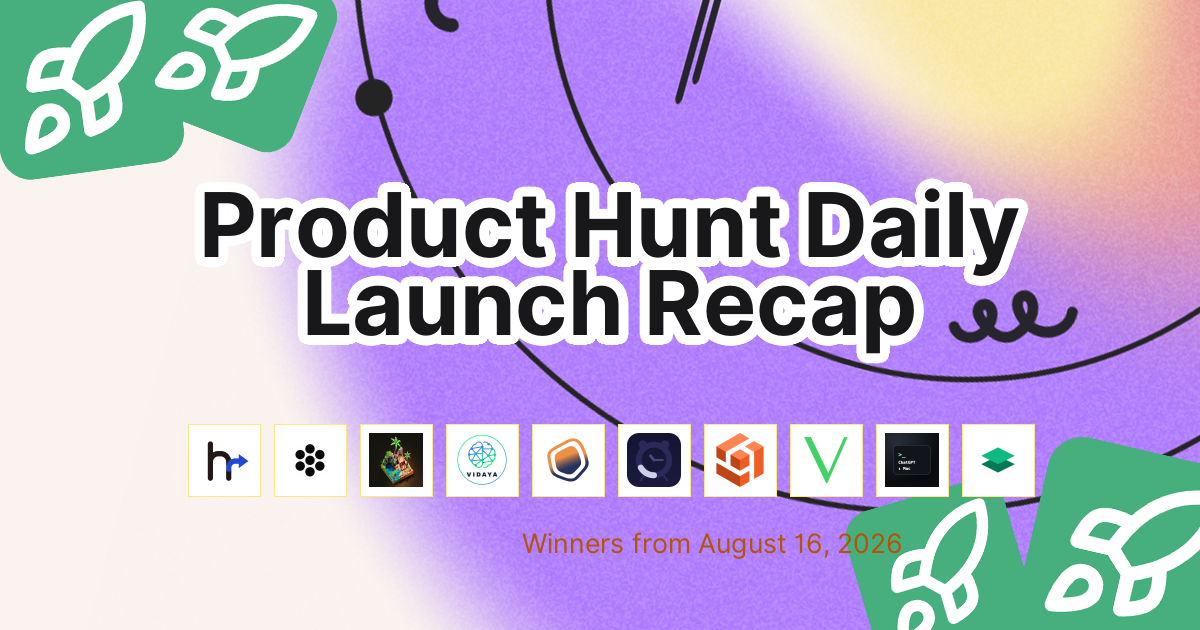
Product Hunt’s top ten for August 16, 2026 reads like a snapshot of where product builders are actually spending time: agent infrastructure, documentation, learning, health, and a growing set of tools that wrap AI around real workflows rather than around generic chat. The top of the board was dominated by products that reduce integration friction, while the lower half revealed a strong appetite for more specialized utilities that try to make an AI assistant useful inside a specific context.
What makes this day interesting is not just the number of AI-adjacent launches, but the way they differ in posture. Some products sell control and infrastructure. Others sell simplicity. A few are clearly trying to turn a familiar category into something more intelligent without losing the shape users already understand. That mix tells founders something important: on crowded launch days, the products that climb tend to have a sharp, concrete promise and a very visible reason to exist.
1HarnessRouter Community Edition
 HarnessRouter Community Edition took the #1 spot with 343 votes and 52 comments, which is a strong signal for a product that sits deep in infrastructure rather than at the surface of end-user delight. It positions itself as an open-source unified interface for agent harnesses, letting teams plug in Codex, Claude Code, and Hermes through one API on their own infrastructure. The pitch is straightforward but potent: switch harnesses without rebuilding your backend, while keeping sessions, streaming, files, artifacts, cancellation, and recovery under your control.
That framing likely helped it stand out. Instead of talking about “agentic AI” in the abstract, it speaks directly to the cost founders and engineering teams feel when they have to rewire an application every time the underlying model or harness changes. The mention of Gateway, Runner, and Console in one Docker container makes the product feel immediately deployable rather than aspirational, and the open-source Apache 2.0 angle lowers the barrier to trust. High vote volume plus a healthy comment count suggests the launch resonated not just as a concept, but as something technical buyers could imagine adopting.
2Blume
 Blume landed at rank 2 with 298 votes and 12 comments, which paints the picture of a polished product that people quickly understood. It calls itself an AI-ready, Markdown-first documentation framework and makes a practical promise: ship beautiful, fast documentation from plain markdown with search, theming, SEO, and one-command deploys on Astro and Vite. The product is not trying to reinvent docs from scratch. It is trying to make the familiar documentation stack easier, cleaner, and more future-proof.
That positioning matters because docs tools live or die on clarity. Blume’s pitch is compact, concrete, and easy to evaluate. For founders, the takeaway is that “AI-ready” works best here as an enhancement to an already useful base, not as the entire identity of the product. The relatively modest comment count compared with its vote total suggests broad appreciation without much controversy, which is often what happens when a utility product hits a nerve quietly and cleanly.
3Expeditione
 Expeditione finished third with 260 votes and 40 comments, and it may have been the most distinct product in the top tier. Built by a single person, it describes itself as an interactive 3D encyclopedia designed to make learning memorable through handcrafted, explorable worlds. It runs directly in the browser, requires no login, avoids ads and tracking, and keeps the first three expeditions free forever. The product also includes educator resources, which gives the launch a second audience beyond casual learners.
What helped here was likely the combination of originality and restraint. The product is ambitious in form, but the experience is framed in plain language: you do not just read about a subject, you enter it. That is a far more vivid promise than “interactive learning platform,” and it seems to have earned meaningful discussion as well as votes. The fact that it is lightweight and browser-based also matters, because educational products often lose momentum when they feel heavy or gated. Expeditione’s launch suggests that a well-specified experience can still compete with more enterprise-oriented AI tools.
4Vidaya
 Vidaya came in at #4 with 244 votes and 32 comments, and it sits in a category that has become increasingly crowded: personal health optimization. Its hook is a healthspan score derived from wearables, labs, and habits, paired with a personalized longevity plan. The launch message is notable for what it rejects. The makers say they were tired of dashboards that show numbers without telling you what to do next, which turns the product into a response to a common frustration rather than just another health tracker.
That framing likely gave Vidaya a stronger narrative than a generic wellness app would have. People do not just want more data; they want interpretation and action. By centering the “what should I do next” problem, the product gives the audience a clear reason to care. Its vote total is substantial, and the comment count suggests the topic is engaging enough to generate discussion, which is often the case when a product tries to translate complex personal data into something simple and useful.
5Chert
 Chert ranked fifth with 212 votes and 26 comments, and its positioning is easy to grasp immediately: it is “Vapi for FaceTime.” The product lets builders create and deploy AI video agents that can answer and place FaceTime calls with just a few lines of code. The use cases listed are practical and specific, including remote support, field service, telehealth intake, and guided onboarding. The launch also invites people to try it live by FaceTiming an agent and showing it something.
That last detail is likely doing a lot of work. It turns the launch from a claim into a demo. For a product about interactive AI agents, proof matters more than pitch. Chert appears to have benefited from a simple, memorable category translation, plus a set of use cases that are easy for founders to picture. The vote and comment totals suggest genuine curiosity, and the product’s appeal seems tied to its ability to make a new interface feel immediately understandable rather than futuristic.
6AirAlarm
 AirAlarm placed sixth with 124 votes and 7 comments, which makes it one of the quieter launches on the page, but also one of the most focused. It turns an iPhone and AirPods into a gentler sleep alarm, waking users at the end of a 90-minute sleep cycle. The product emphasizes what it does not require as much as what it does: no Apple Watch, no account, no ads, no analytics, and no cloud sleep profile. That kind of minimalism is part of the pitch.
In a day full of agent platforms and AI integrations, AirAlarm stands out by solving a very human, very specific problem without overcomplicating it. The vote total is lower than the infrastructure launches above it, but the simplicity of the concept makes it easy to understand at a glance. Products like this often do well with a narrow audience because they feel honest about scope. The launch suggests that there is still room for small, sharply defined consumer utility products when the promise is immediate and the setup is lightweight.
7CostLogic
 CostLogic earned rank 7 with 116 votes and only 2 comments, which hints at a launch that may have been highly relevant to its target users without creating much public debate. The product is a construction takeoff and job-costing workspace powered by an agent called Onyx. Users can upload plans, detect rooms, calibrate scale, measure quantities, turn takeoffs into estimates, and send invoices in one browser-based workflow. The promise is to remove the need to stitch together several different tools and to compress work that once took days into hours or minutes.
This is a classic vertical workflow launch, but the AI agent framing gives it extra momentum. Rather than presenting AI as a novelty, CostLogic uses it to reduce repetitive labor inside a concrete trade. That likely helped the product feel credible. The low comment count may indicate a launch that was more immediately useful than conversational, which is not unusual for specialized B2B software. Founders watching the day should note how often the strongest AI products are the ones that stay close to an existing job and improve it end to end.
8Vaaya
 Vaaya took eighth place with 54 votes and 12 comments, and it is one of the more unusual launches on the list. The product asks users to turn their GitHub profile into a kind of credit card for their agents, building an “agentic credit score” and giving agents money to spend. It also promises access to more than 1,400 tools, including Exa, Firecrawl, Fal, Apollo.io, Browserbase, and Modal, through a single MCP installation. The idea is clearly aimed at builders experimenting with agent capabilities and tool access.
What makes Vaaya memorable is the combination of metaphor and utility. The credit score concept is unusual enough to catch attention, while the tool ecosystem and simple installation line ground the launch in actual developer needs. Its vote count is modest compared with the top of the board, but the comments suggest that people were intrigued enough to talk about it. That is often the pattern with launches that introduce a new mental model. They may not draw broad mainstream attention immediately, but they can still become useful reference points for a community trying to define how agents should operate.
9Mac Developer Bridge
 Mac Developer Bridge landed at #9 with 19 votes and 4 comments, a much smaller result than the products above it, but the idea itself is clean and provocative. It is an open-source MCP bridge that lets ChatGPT operate a real Mac through shell access, files, PTY sessions, background jobs, and read-only Codex history. The launch positions ChatGPT as the reasoning layer and the Mac as the execution environment, and it stresses that the tool is MIT licensed and intentionally not sandboxed.
That last point is probably the headline as much as the functionality. The product is aimed at power users who want actual control over their machine rather than a constrained abstraction. The low vote count suggests a niche audience, but one that may be especially aligned with the Product Hunt community’s appetite for experimental developer tooling. When a launch is this direct about what it enables, it does not need broad appeal to feel interesting. It simply needs to articulate a capability people have wondered about but not yet seen packaged this plainly.
10Assetli.app
 Assetli.app rounded out the top ten with 20 votes and 1 comment, which makes it one of the lightest launches on the board in terms of public engagement. Still, the product has a clear angle: personal finance and net worth tracking wired to AI. It connects directly to Claude or ChatGPT via MCP so an assistant can read a user’s real net worth, transactions, and portfolio, and update them inside the AI chat. The product also covers stocks, crypto, real estate, vehicles, and valuables, and includes FIRE, mortgage, and rent-vs-buy calculators. It explicitly avoids forced bank linking, allowing imports via CSV or PDF.
The launch sits at the intersection of trust and convenience, which is always difficult territory in financial products. Assetli tries to reduce friction by making AI the interface, while also reassuring users that the company never sees their data and that bank linking is not required. With only a single comment, the launch did not create much public conversation, but it does reflect a broader pattern on the day: founders keep looking for ways to make AI an operating layer over existing records and routines, rather than a standalone novelty.
What founders can learn from this launch day
The clearest lesson from August 16 is that specificity still wins. The launches that drew the most attention did not simply announce “AI features” or “a smarter workflow.” They named a job, a constraint, or a switch point that users immediately recognize. HarnessRouter is about changing agent harnesses without rebuilding backend systems. Blume is about shipping docs from plain markdown. Chert is about FaceTime as an agent interface. That level of precision makes a launch easier to understand, easier to discuss, and easier to judge.
A second pattern is that founders are increasingly using AI to sit on top of existing systems rather than replace them. Several products on the board are essentially interfaces, bridges, or coordinators. They do not ask users to abandon their current tools. They try to reduce the friction between what users already have and what they wish those tools could do. That is a strong launch theme because it speaks to adoption. Buyers are more willing to try something that fits into their current stack than something that demands a wholesale reset.
The day also shows that strong launches are not always the loudest. Some of the most interesting products had relatively small vote totals but very clear identities. AirAlarm, Mac Developer Bridge, and Assetli.app were all narrower than the top-ranked infrastructure launches, yet they were easy to describe in a sentence. For founders, that is a useful reminder that Product Hunt success is not just about breadth; it is about whether people can instantly see the product’s shape, audience, and reason to exist.
Finally, this launch day reinforces how much launch performance depends on trust cues. Open source, local control, no tracking, no forced bank linking, MIT licensing, one-command deploys, and browser-based workflows all show up as confidence builders. In a crowded AI market, users are not only asking what a product does. They are asking how it behaves, what it keeps, what it automates, and what they still control. The launches that answered those questions clearly were the ones that found room to rise.
