
Product Hunt on September 27, 2026, split neatly between ambitious AI products, practical workflow tools, and a few launches that leaned on delightful form as much as utility. The top of the leaderboard was especially strong: the day’s winner pulled well ahead with 333 votes, while the next few launches stayed close enough to suggest a busy, competitive launch day rather than a runaway viral moment. For founders, that makes the ranking interesting in a different way. It is less about one dominant narrative and more about how products earn attention when they speak clearly to a specific job, audience, or emotion.
What stands out across the day is how often the best-performing products framed themselves around a concrete use case instead of a broad promise. The launches that did best were not necessarily the ones with the biggest ambitions on paper, but the ones that made those ambitions legible in a sentence or two. Whether it was AI NPCs inside a roleplay server, a second opinion on model outputs, or an assistant that lives directly inside existing work tools, the strongest launches gave voters something easy to grasp and easy to talk about.
1Humalike x GTA RP
 Humalike x GTA RP took the top spot with 333 votes and 32 comments, which is a strong showing for a product that sits at the intersection of gaming, simulation, and AI character behavior. The product’s pitch is unusually vivid: AI NPCs that talk, remember, and act on their own, with characters and entire societies built around memory, personality, and voice. It is not just an AI feature layered onto an existing game mechanic. The launch is positioned as a new roleplay experience, and that framing matters because it makes the product feel like a world rather than a tool.
The description also does something smart for Product Hunt: it grounds the concept in a live context. By saying it is already live on Poland’s largest roleplay server and can now be added to yours, the team gives the launch a sense of proof and immediacy without overexplaining the technology. That likely helped it stand out in a feed full of abstract AI products. Voters can picture the experience quickly, and comments tend to come more naturally when a launch invites people to imagine how it changes behavior in a familiar setting.
2GPT-6 Sol & Luna

GPT-6 Sol & Luna finished second with 322 votes, but only 7 comments, which suggests a launch that drew broad attention faster than it drew conversation. The positioning is straightforward and highly legible: frontier AI intelligence at half the price. OpenAI’s framing leans on speed, cost, and improved model behavior, including lower API pricing, stronger factuality and coding, better prompt caching, and alignment improvements. The launch is clearly meant to signal product maturation rather than a moonshot announcement.
That combination of familiar brand weight and very concrete benefits almost certainly helped it collect votes quickly. A launch like this does not need to persuade people that the category matters; it needs to explain what changed. Here, the message is that the models are cheaper, faster, and more useful across ChatGPT Work, Codex, and the API. The low comment count is interesting because it may indicate that the audience treated it more like a major platform update than a conversation starter, which is common when the company already sits near the center of its market.
3Cuey
 Cuey earned third place with 271 votes and an unusually lively 41 comments, one of the stronger comment totals in the top 10. The product is built around a pain point many AI users now recognize immediately: the model sounds confident even when it is wrong. Cuey’s answer is to compare responses across ChatGPT, Claude, Gemini, and 30-plus other models in one tab so users can see where they disagree and what their first model missed. The idea is simple enough to understand, but pointed enough to feel timely.
Its positioning is especially effective because it turns model comparison into a workflow, not a research exercise. There is no copy-pasting between tabs and no need to repeat the same prompt over and over, which makes the product feel practical rather than academic. The comments volume suggests that the launch invited debate and curiosity, likely because it speaks directly to a real anxiety among AI users: how do you trust an answer when the output is polished but not necessarily correct? That is the sort of question Product Hunt audiences like to discuss.
4Superhuman Go
 Superhuman Go placed fourth with 197 votes and 6 comments, a strong but fairly focused result for a product that is all about meeting users where they already work. The pitch is that it operates inside Gmail, Slack, documents, and the browser, nudging better phrasing, drafting replies in your voice, and prepping meetings before you think to. It also adds no-code agents that can run on their own schedule. That is a broad workflow promise, but the launch keeps it grounded in everyday surfaces rather than abstract automation.
This is the kind of product that benefits from immediate relevance. Many founders and operators spend their day in exactly those tools, so the launch does not need a lot of explanation to be felt as useful. The low comment count relative to votes suggests the value proposition was easy to absorb, which can create a quieter but efficient kind of attention. It is also notable that the product is described as free to start, which lowers the barrier for a Product Hunt audience that likes trying tools quickly before deciding whether they will fit into a workflow.
5KiwiDesk
 KiwiDesk landed in fifth with 147 votes and 10 comments, making it one of the more concrete utility launches of the day. It is a tiling window manager for macOS, but the positioning avoids the usual dry language around productivity software. Instead, the pitch says it feels like it shipped with macOS. That matters because the product is clearly trying to appeal to users who want more structure without sacrificing the native feel of the platform. It offers seven layouts, shortcut-based app launching, a draggable Space Bar for mouse users, and profile-based behavior tied to macOS Desktops.
The launch also does something many utility products forget to do: it lowers the intimidation factor. Everything is configured in a native Settings app, there is no config file, and the source is on GitHub. That combination makes the product feel accessible to both power users and people who simply want their windows to behave better. A modest comment count here likely reflects a niche audience rather than a lack of interest. In that niche, clarity and polish are often enough to earn votes without provoking a lot of debate.
6Harmony
 Harmony reached sixth place with 140 votes and 13 comments, and its pitch is one of the more operationally ambitious in the top 10. It is an AI-native ITSM platform built around agents that handle IT and HR requests directly inside Slack and Teams. Rather than bolting a chatbot onto a ticketing tool, the product is described as a helpdesk built around AI agents from the start. That distinction is important because it reframes the launch from “yet another support bot” into a workflow system with a different architecture.
The description is filled with specifics that signal seriousness: 100-plus production-ready agents, end-to-end handling for password resets, app access, onboarding, and device issues, plus ticketing, asset inventory, SaaS management, and workflows in one workspace. It is the kind of launch that asks buyers to imagine real internal operations, not a demo. The comment count suggests the Product Hunt audience engaged with it enough to ask questions or react to the scope, which makes sense given how many teams are still trying to turn fragmented support into something more automated without losing control.
7Clicks Communicator
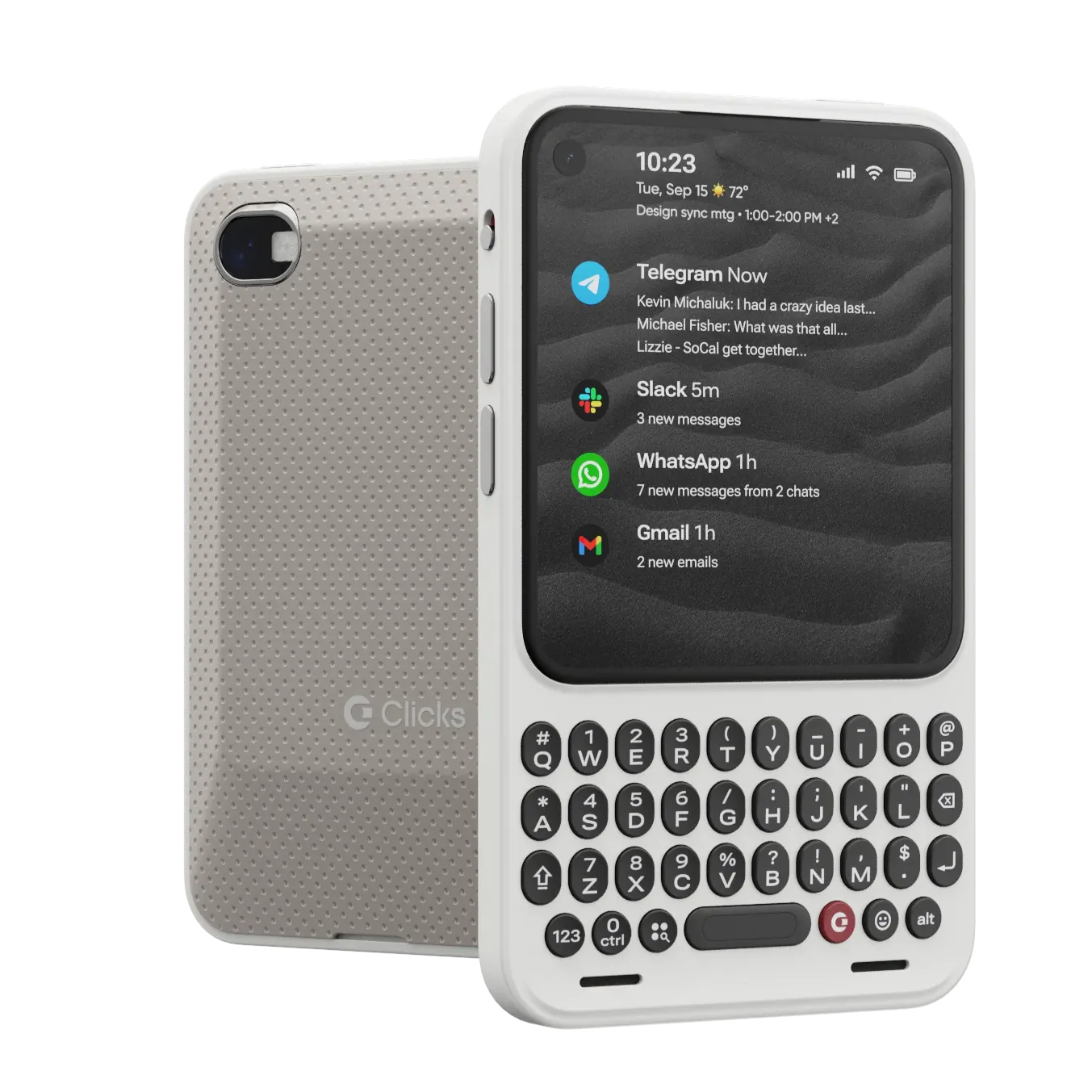 Clicks Communicator came in seventh with 134 votes and 9 comments, and it is one of the day’s more unusual launches because it is hardware as much as software. The product is a compact Android 17 phone with a physical keyboard and a home screen designed around conversations. It can serve as a main phone or a companion device, and the pitch emphasizes typing, quick replies, and keeping messages close at hand while still supporting full 5G and apps. That gives it a clear identity in a market that often treats hardware as disposable or overgeneralized.
What likely helped this launch is the specificity of the use case. The company is not trying to sell a generic smartphone. It is selling a different interaction model for people who care about doing, typing, and messaging faster. The description also makes the audience choice obvious: users who miss physical keyboards or want a more communication-centered device will immediately know whether it is for them. On Product Hunt, products that are easy to self-identify with tend to get traction even when the category is niche.
8NiroHelp
 NiroHelp placed eighth with 36 votes and 5 comments, which is a much smaller result than the launches above it but still enough to make the top 10 on a day with a crowded field. The product is an AI-native support layer for WordPress that uses a company’s docs to answer customer questions in chat and reply to tickets automatically. The positioning is practical and direct: help support more customers with a smaller team and lower costs, while letting humans step in when the AI is unsure. That is a familiar promise, but it is packaged around a platform many small businesses already use.
The launch likely benefited from being tightly scoped. WordPress is a huge ecosystem, and support pain is universal enough that the pitch does not need much explanation. The product also respects the limits of automation by explicitly handing off uncertain cases to the team, which makes the pitch feel more credible. Its lower vote total and modest comment count suggest it may have appealed to a narrower audience, but that audience is probably well-defined and easy to reach. That can be an advantage for founders who do not need mass appeal to find early traction.
9Lofi Cities
 Lofi Cities finished ninth with 20 votes and 16 comments, which is a fascinating ratio. The votes are modest, but the comment count is relatively high for the ranking, suggesting the launch sparked conversation even without broad voting support. The product offers 16 animated pixel-art cities with endlessly browser-generated lofi music, and it lets users adjust weather, city sounds, focus or sleep timers, and even floating reactions and lantern releases. It is built as a sensory experience as much as a utility.
That unusual blend of atmosphere and interaction likely explains why people talked about it. Unlike many productivity launches that sell efficiency, this one sells a mood, a place, and a ritual. The fact that it works free, without an account, and offline after the first visit lowers friction and makes the experience easy to try. For Product Hunt, that is often enough to create engagement even if the product is not aiming for the biggest possible audience. It is also a reminder that launches do not need to be massive to be memorable.
10QueroCura
 QueroCura closed the top 10 with 19 votes and 13 comments, another case where the comment count is relatively healthy compared with the votes. The product describes itself as the future of connected healthcare, with personalized care at home and a system that helps users understand symptoms, remember the next dose, and keep their health story in one trusted place. The pitch is broad, but the core idea is clear: make care feel continuous rather than scattered.
This launch likely stood out because health products often win attention when they speak in simple, human terms. “Understanding your symptoms” and “remembering your next dose” are concrete actions that anyone can imagine using. Even without large vote volume, the discussion rate suggests the topic resonated enough to prompt questions or reactions. That can be a useful signal for founders in regulated or sensitive spaces: you may not get the same kind of broad, quick voting that a consumer AI launch does, but you can still earn attention by making the product’s promise feel personal and immediate.
What founders can learn from this launch day
The clearest lesson from this Product Hunt day is that specificity still wins attention. The launches that rose highest did not rely on broad claims about the future. They named a setting, a workflow, or a pain point that people could recognize immediately. Humalike x GTA RP made the world concrete. Cuey turned AI reliability into a comparison workflow. Harmony anchored itself in Slack and Teams. Even the more niche products, like KiwiDesk and Clicks Communicator, knew exactly what kind of user they were for and said so plainly.
A second lesson is that votes and comments are not the same signal. Some launches, like GPT-6 Sol & Luna and Superhuman Go, drew votes efficiently without generating much back-and-forth. Others, like Cuey, Lofi Cities, and QueroCura, created more conversation relative to their vote totals. For founders, that matters because a launch can succeed in more than one way. You can win with reach, or you can win with resonance. The best teams on Product Hunt seem to know which one they are aiming for.
Finally, the day reinforced a pattern that has become increasingly visible in launch culture: products that feel native to an existing behavior are easier to explain and easier to adopt. The strongest launches were not asking people to change everything at once. They fit into a game server, an inbox, a browser tab, a support stack, a phone, or a window manager. That makes the message simpler and the product easier to imagine using tomorrow. For founders planning their own launch, that is often the real edge: not just building something useful, but making the first sentence about it unmistakably clear.
