
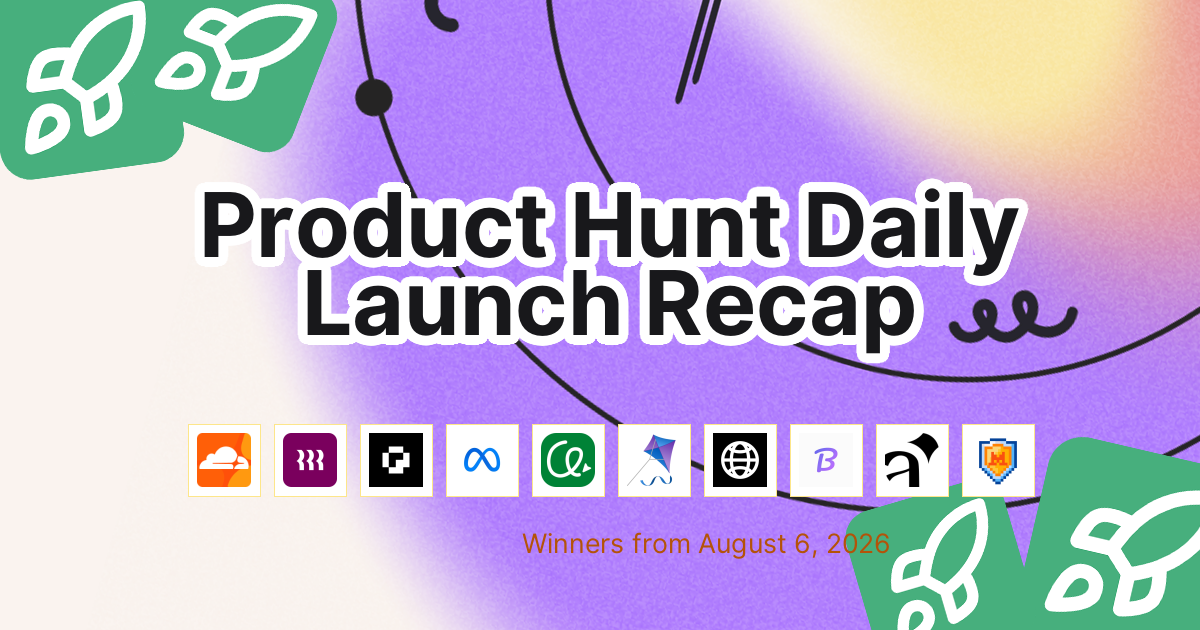
Product Hunt on 2026-08-06 was unmistakably about one thing: making AI systems feel less like isolated demos and more like infrastructure founders can actually ship. The top launches clustered around agents that work inside real workflows, connect to existing tools, and expose enough control to make them useful in production. That theme showed up across operating systems, spend tracking, debugging, publishing, brand context, and guardrails.
What makes a day like this interesting is not just that AI dominated the board. It is that the strongest launches were not generic “AI for everything” claims. They were specific answers to specific operational pain points, and the votes and comments suggest founders and operators are now rewarding products that fit into how teams already work. The most successful launches did not ask users to start over; they tried to make current systems smarter, safer, or easier to reason about.
1Cloudflare OS
 Cloudflare OS took the top spot with 450 votes and 4 comments, which is a strong signal for a launch built around a big, platform-level idea. The product is positioned as an open source AI operating system for companies, one that gives every person an agent and workspace shaped around the company’s own context, tools, and rules. That framing is ambitious, but it is also concrete enough to resonate with founders who are trying to move beyond one-off copilots.
The way it was pitched matters. Rather than selling a single assistant, Cloudflare OS is presented as a foundation layer that companies can shape around how they already operate. That is the kind of message that tends to travel well on Product Hunt because it suggests extensibility, control, and ownership all at once. The low comment count relative to the vote total may suggest that the audience responded quickly and decisively to the concept itself, even if the discussion stayed compact.
What likely helped it stand out was the combination of open source and operating-system language. Founders are increasingly wary of AI tools that feel boxed in, and this launch speaks directly to the desire to build around company-specific context rather than a generic model experience. A product that promises structure, customization, and AI-native workflows is going to feel more strategic than another assistant widget.
2AI Spend Console by Rippling
 AI Spend Console by Rippling landed at rank 2 with 318 votes and 124 comments, one of the loudest conversation signals on the board. The product gives Finance and Engineering leaders a single place to track AI spend across tools like Claude and Cursor, then connect that spending to business outcomes. It breaks costs down by vendor, model, or employee and even connects spend to GitHub output data such as pull request volume and code revisions.
That positioning is smart because it turns a vague budget conversation into something measurable. A lot of teams are suddenly paying for AI in many places at once, and the challenge is no longer whether to adopt these tools, but how to understand whether the expense is helping. The fact that it is available free to start, with no Rippling subscription required, likely lowered the barrier for people who were curious but not ready for a broader vendor commitment.
The comment volume suggests the topic hit a nerve. Spend attribution, productivity measurement, and ROI for AI are all questions finance and engineering leaders are wrestling with in real time. Rippling’s launch stood out by making the problem legible in business terms, not just technical ones. That is often the difference between a tool people admire and a tool people actually want to trial.
3Superlog Responder
 Superlog Responder came in at rank 3 with 290 votes and 39 comments, and it has the kind of pitch that immediately makes sense to engineering teams. It is a free, open-source AI bug-fixing agent that plugs into an existing Sentry or Datadog Slack channel, syncs with one click, and starts investigating alerts with full context. For real issues, it responds in-thread with the root cause, supporting evidence, and a mergeable PR.
This is a strong example of a launch that reduces friction before it adds intelligence. The team did not ask users to install a new monitoring workflow or replace their alerting stack. Instead, it slides into a channel many teams already live in, which makes the product feel practical rather than aspirational. The emphasis on customizable prompts, memory, repo access, and escalation rules also signals that this is meant to be adapted, not merely consumed.
Its result suggests there is solid appetite for agents that do one job well inside an existing operational path. The vote total shows broad interest, while the comments indicate enough curiosity to spark discussion without overwhelming the launch. What likely helped Superlog Responder stand out was that it translated a familiar pain point, noisy alerts, into a concrete outcome: less triage, faster diagnosis, and an actionable code change.
4Muse Code
 Muse Code ranked 4th with 231 votes and 3 comments, which gives it a quieter profile than some of the other AI launches on the day. Meta describes it as a terminal coding agent powered by Muse Spark 1.2, with persistent background agents, repository-scale execution, and built-in verification. The framing is unmistakably aimed at serious development workflows rather than casual prompt-and-response use.
The product’s positioning leans into long-horizon coding, which is a meaningful distinction. Persistent background agents and repository-scale execution imply that the tool is intended to keep working through larger tasks, not just answer isolated coding questions. Built-in verification adds another layer of credibility because it suggests the system is trying to close the loop on correctness, not just code generation.
The relatively low comment count may reflect the fact that the launch message is easy to understand but less likely to provoke debate than a product centered on budgets or workflow disruption. Still, the vote total shows clear interest in terminal-based agents that fit the environment developers already trust. In a crowded coding assistant category, the products that stand out tend to be the ones that sound like they are built for real scale, and Muse Code was very deliberately framed that way.
5Annotate
 Annotate ranked 5th with 203 votes and 19 comments, and it offered one of the day’s simplest ideas. The product turns screen recording into prompts: you record your screen, point by drawing, speak your instructions, and hand it off to an AI agent. It is pitched as a free, local-only way to create video prompts for Cursor, Claude, Codex, or any AI coding agent.
That positioning is useful because it solves a very practical communication problem. Instead of trying to explain a bug, workflow, or UI change in text, users can show the problem visually and narrate the intent. The fact that it is local-only matters as well, especially for teams who are cautious about where their internal screens and workflows go. Privacy is not the main headline, but it is clearly part of the trust story.
Annotate’s results suggest there is room for lightweight tools that improve how people collaborate with agents, not just the agents themselves. It does not need a complex enterprise narrative to be compelling. The product stands out because it makes a familiar action, screen recording, feel native to AI workflows, and that kind of bridge often resonates strongly with founders and builders.
6CopilotKit Channels SDK
 CopilotKit Channels SDK reached rank 6 with 152 votes and 23 comments. The pitch is broad but clear: bring any agent into Slack, Teams, WhatsApp, and other channels, while keeping coworker-grade capabilities like streaming responses, generated UI, per-user learning, human-in-the-loop approvals, and more sophisticated auth. It is open source, self-hostable, and works with several agent stacks, which gives it a platform-agnostic appeal.
This launch reads like infrastructure for the next phase of agent deployment. A lot of companies can now build agents, but the harder problem is putting them where employees already work and making them feel safe enough to use. By emphasizing channels and approvals, CopilotKit is speaking to the operational reality of enterprise adoption rather than just the novelty of an agent interface.
The vote and comment mix implies a product that the technical audience understands quickly but also wants to discuss. That makes sense given the scope of the promise. If your product can become the layer that routes agents into workplace channels, then the story is less about one use case and more about becoming a default distribution path. That kind of positioning tends to attract builders who are thinking about ecosystems, not just features.
7Website to Markdown API
 Website to Markdown API landed at rank 7 with 133 votes and 9 comments, and it did exactly what the name promises. Submit a URL, and the service returns clean Markdown, with JavaScript-rendered pages handled automatically and clutter like navigation, footers, and cookie banners stripped out. The output is designed to go straight into an LLM context window or knowledge base without extra cleanup.
The product’s positioning is all about reliability and format fidelity, which matters a lot more than it sounds. If you are building retrieval, ingestion, or content pipelines, the difference between raw web content and usable Markdown can save a lot of engineering time. The added support for PDFs, DOCX, PPTX, images, audio, and video broadens the appeal, but the core value still comes from making messy content immediately usable.
Its place on the leaderboard suggests that utility products with clear operational value can still find a strong audience even on a crowded AI day. The votes point to a real need, and the comments likely reflect practical curiosity rather than hype. What likely helped it stand out was its focus on one annoying but recurring step in AI workflows: getting content into a clean, machine-ready form.
8Brandfetch MCP
 Brandfetch MCP ranked 8th with 134 votes and 5 comments, just ahead of a few close competitors on vote count. Its pitch is direct and easy to grasp: stop your AI from guessing brand logos. The product gives agents access to logos, colors, fonts, company details, and broader brand context for more than 50 million brands, and it works with tools like Claude, Cursor, VS Code, and Codex.
This launch stands out because it is solving a problem that many teams probably did not know they had until they saw AI make it. Generative systems are famously bad at brand consistency when left unchecked, so the product is less about novelty than about correction. By framing the issue around logos and visual identity, Brandfetch MCP makes a technical integration feel relevant to designers, marketers, and builders at the same time.
The ranking and vote count suggest a solid but more focused audience than the top few launches. That makes sense for a tool that is very specific in what it fixes. Still, the pitch is strong because it packages brand correctness as infrastructure for agents. The fact that it plugs into multiple environments likely helped it feel like a practical add-on rather than a niche point solution.
9Aveiro
 Aveiro took rank 9 with 120 votes and 4 comments. It describes itself as an AI-native publishing platform for sites, blogs, newsletters, and social media, with creation and management available through the interface or through MCP connections to ChatGPT, Claude, and Cursor. That combination makes the product feel aimed at teams that want content operations to be more programmable without giving up a familiar publishing workflow.
The positioning is interesting because it blends editorial software with agent connectivity. Rather than treating AI as a writing assistant bolted onto a CMS, Aveiro frames publishing itself as something agents can participate in. That can be attractive to founders and small teams who need to publish across multiple formats but do not want to manage separate systems for each channel.
The modest vote and comment totals suggest a product that may appeal most to a specific audience rather than the broader Product Hunt crowd. Even so, the concept is timely. Founders are increasingly looking for ways to produce more content with less manual coordination, and Aveiro’s appeal comes from making that process feel integrated instead of fragmented.
10Shieldstral
 Shieldstral closed the top 10 at rank 10 with 112 votes and 1 comment. It is a 3B open-weight multimodal guardrail from Mistral that lets users define safety policies in natural language at inference time. It evaluates text, images, or both from a single token output and can run locally on a single 16GB GPU.
That is a notably technical launch, but the positioning is elegant. Instead of forcing teams to hardcode safety logic or rely only on external moderation layers, Shieldstral offers policy definition at runtime. That matters for builders who need flexibility, especially when AI systems must handle more than one modality and still operate within specific constraints.
The small comment count suggests this was a launch more likely to be appreciated than debated. But the vote total still shows meaningful interest in lightweight, local guardrails, particularly when tied to open weights and runtime configurability. What likely helped Shieldstral stand out was its combination of control, compactness, and multimodal scope, all of which fit the broader theme of making AI systems easier to govern.
What founders can learn from this launch day
The clearest lesson from 2026-08-06 is that AI products are winning when they reduce operational friction rather than merely demonstrate capability. The launches that rose fastest were the ones that fit into existing environments, whether that meant Slack, a terminal, a browser workflow, a finance dashboard, or a publishing stack. Founders looking at this day should notice that integration is not a secondary feature anymore. It is often the product.
Another pattern is that trust and control were as important as raw intelligence. Open source, local-only, self-hostable, customizable, and runtime policy definitions all showed up across the board. That suggests buyers are asking harder questions about where their data goes, how agents behave, and whether the system can be shaped to match company rules. The most compelling launches were not just smart; they were bounded.
There is also a subtle but important signal in the vote and comment mix. Some launches earned attention through broad appeal and clear utility, while others sparked heavier discussion because they touched budgets, workflows, or the future of developer tooling. That means founders should think carefully about the kind of conversation they want a launch to start. If the goal is quick adoption, the pitch should be painfully concrete. If the goal is strategic positioning, the story needs to explain why the product changes how a team works, not just what it does.
Overall, this launch day favored products that made AI feel more operational, more measurable, and more governable. That is a useful reminder for anyone shipping in 2026: the market is past the phase where “AI-powered” is enough. What matters now is whether the product can slot into a real workflow and improve it without demanding that the user rebuild everything around it.
