
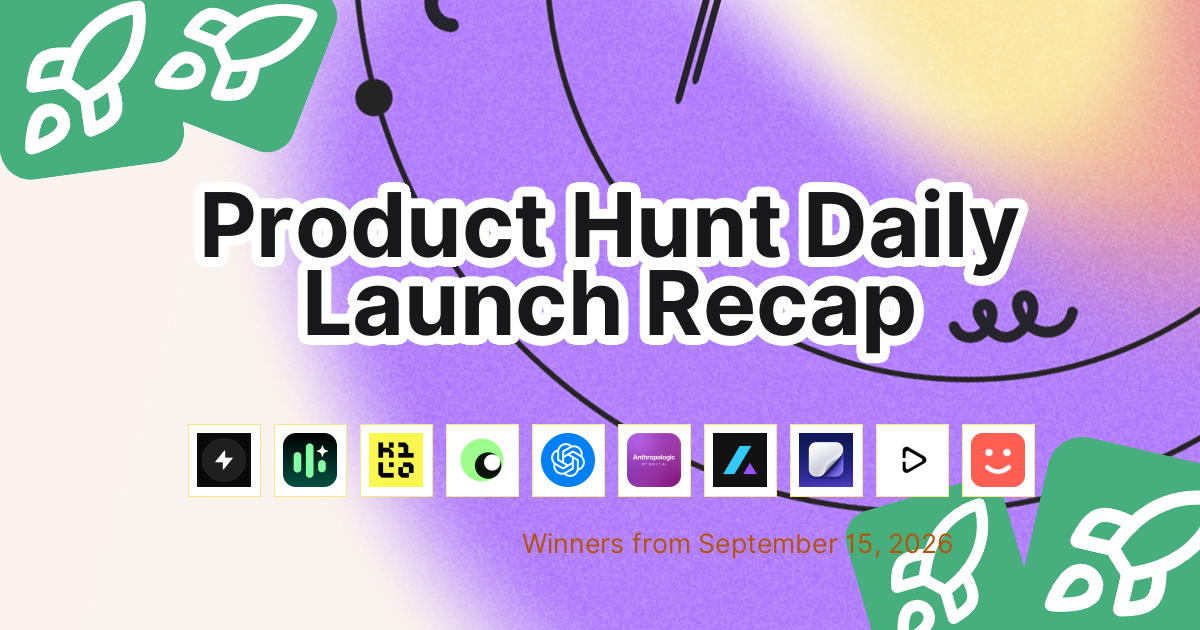
Product Hunt’s September 15th slate had a very clear center of gravity: builders building for builders, with AI threaded through almost every launch in some form. The strongest entries were not just “AI-powered” in the generic sense. They were products trying to collapse a workflow, remove setup friction, or turn scattered work into something more operational. That made the day feel less like a parade of demos and more like a collection of sharp answers to specific pains founders already know well.
What also stood out was how many of the launches were positioned around immediacy. Several products promised you could start faster, move work into one place, or offload routine effort without creating yet another system to manage. The vote totals suggest that Product Hunt voters responded to that practical framing: the top four launches all cleared 250 votes, and even the lower half of the list still attracted meaningful attention and conversation for products with narrower use cases. For founders, that is often the clue. Clear pain, concrete outcome, and a promise that feels usable right away still travels.
1tiun.
 Ranked #1 with 534 votes and 105 comments, tiun. set the tone for the day by speaking directly to a familiar founder problem: the boring but unavoidable infrastructure needed to launch a paid AI product. Its pitch was simple and unusually complete. It bundles auth, billing, payments, customer data, and analytics into one system, with one command to install, so an AI builder can get to a paid launch without stitching together a stack of tools first.
That positioning matters because it does more than describe features. It frames tiun. as a time-to-market product, not just a backend utility. The result on Product Hunt suggests that message landed well. High votes and a solid comment count usually indicate a launch that feels immediately legible, and that seems true here. Founders do not need to imagine the use case; they can picture the first week of a new product and see where this fits.
What likely helped it stand out was the combination of breadth and urgency. Plenty of products help with one part of the launch process, but tiun. claims to reduce the operational drag across several of them at once. That gives it a broader appeal than a single-purpose tool, while still staying grounded in the day-to-day reality of shipping something paid.
2Voiskey
 Voiskey came in at #2 with 489 votes and 146 comments, which is a strong sign that it struck a nerve beyond simple novelty. The product’s core idea is AI voice typing that rewrites what you meant, not just what you said, and adapts the result to context. A rough thought can come back as something casual, composed, or technical depending on where it is headed. That framing gives the product a clearer identity than a generic dictation app.
The launch also benefited from specificity. Voiskey is available on iOS, macOS, Android, and Windows, works in more than 100 languages, and is free to start with a launch-time month of Pro. Those details matter because they make the promise feel broad but not vague. The product is not asking users to adopt a new workflow in one place. It is asking them to treat voice as a cross-device input method that can actually keep up with real writing contexts.
The comment count is especially interesting here. Voice tools often get attention for convenience, but comments usually rise when people can argue about quality, habit change, or whether the product genuinely feels natural. Voiskey’s pitch clearly gave people something to react to. The combination of speed, polish, and multilingual reach likely helped it feel both practical and ambitious.
3Kilo Code for iOS and Android
 At #3 with 480 votes and 79 comments, Kilo Code for iOS and Android extended the increasingly popular idea that coding agents should not be trapped on a desktop. Its pitch is built around control and response: you can run cloud agents, control VS Code and CLI sessions, review pull requests, and respond to agents from an iPhone, iPad, or Android device. That is a very founder-friendly promise because it follows the way many technical teams already work, with work happening in the background and decisions needing to happen quickly.
The product’s positioning is strong because it is not simply “coding on mobile.” Instead, it treats mobile as a command center for agent-based development. That distinction likely helped it resonate with a Product Hunt audience already familiar with AI-assisted coding, but looking for better operational surfaces around it. The result, with close to 500 votes, suggests a launch that felt timely rather than experimental.
The GIF thumbnail likely helped too, because products like this need motion to communicate the experience. You need to see the idea of remote control and session management, not just read about it. In a crowded AI-dev-tool field, clarity of use case is often the difference between curiosity and actual momentum.
4siift
 siift landed at #4 with 268 votes and 23 comments, and it took a more strategic angle than the tool-heavy launches above it. The product is framed as a way to turn the scattered mess of AI chats, tools, ideas, and advice into a living map of a business. It connects strategy, evidence, decisions, and results in one place, and it is aimed at the messy middle of validation, build strategy, GTM, and growth.
That positioning is interesting because it acknowledges a real problem founders now have: AI creates more input than judgment. siift’s language is about structure, challenge, and focus. Rather than promising more content or more automation, it promises a way to make sense of the noise. For founders and operators, that is a compelling shift in tone, especially when many AI products still lean on productivity theater.
Its vote and comment profile suggests a narrower but thoughtful appeal. It did not draw the same volume of conversation as the top three, but that does not diminish the clarity of the pitch. In fact, the more specific strategic frame may be exactly what makes it memorable. When a product describes the problem in the right terms, it often earns attention from people who already feel that pain.
5OpenAI Agents API
 OpenAI Agents API ranked #5 with 183 votes and just 2 comments, which is a very different kind of launch signal. The product is OpenAI’s managed version of the Codex harness for building cloud agents with one API call instead of custom orchestration. It handles long sessions, tool use, and parallel subagents, and it runs on OpenAI or partner sandboxes with no extra fees beyond token and tool usage.
The launch is important less because of flashy community response and more because of what it represents structurally. This is infrastructure for developers who want managed agent behavior without wiring the whole stack themselves. The public beta and open source harness make the positioning feel practical rather than speculative. That kind of release often draws a more measured response on Product Hunt because the audience already knows the category and is evaluating the implementation, not the concept.
The low comment count tells its own story. Big platform launches can be widely watched but not heavily debated if the value proposition is obvious or if the audience is already familiar with the underlying technology. What likely helped it stand out was the simplicity of the promise: one API, fewer orchestration headaches, and a clearer path to production-grade agents.
6Anthropologic
 Anthropologic came in at #6 with 179 votes and 45 comments, and it tried to reclaim a category that has often been split between speed and depth. The company describes itself as the zero distance consumer research platform, arguing that traditional research is deep but slow, social listening is fast but shallow, and LLMs are fluent but culturally blind. Its answer is a system that reads the internet through a Human Context Protocol to surface consumer, category, and cultural truths.
That is a bold positioning move, and it makes the product feel more like a research operating system than a simple insights tool. The claims around nine workflows, 239 markets, and more than 100 languages give it a global and methodical tone. For founders, the appeal is obvious: quicker answers in a part of the business that is usually slowed by agencies, fragmented tools, or too much manual synthesis.
The launch seems to have benefited from that tension between ambition and practicality. It does not just say “use AI for research.” It argues that current methods fail in specific ways and offers a replacement framework. That kind of narrative tends to generate thoughtful comments because people immediately want to compare it with the way they already work.
7Axari
 Axari ranked #7 with 167 votes and 17 comments, and it brought a security-first spin to the AI twin theme. The product is designed to take on security busywork by letting users assign tasks to an AI twin that understands their security world, works across tools and teams, and keeps moving until the work is actually done. It can be given a goal, allowed to work proactively, or handed recurring responsibilities from Slack or Microsoft Teams.
The positioning is sharp because it targets a role where unfinished work has real consequences. Security teams do not just need automation; they need persistence and coordination. Axari frames AI not as a helper for occasional tasks but as a standing operator that can stay on top of obligations. That is a more mature framing than many AI agent launches, and it likely helped the product feel credible in a domain where credibility matters a lot.
Its vote count shows decent traction, and the lower comment volume suggests the pitch was understood more quickly than debated. The phrase about attackers using AI is the sort of line that gives the launch a clear point of view without relying on generic AI enthusiasm. In a crowded security market, a memorable operating metaphor can do a lot of work.
8PeekPaste
 PeekPaste reached #8 with 118 votes and 10 comments, and it offered a refreshingly restrained product in a day full of broad AI claims. It is a native clipboard manager for Mac that stays out of the way until needed, then slides in when you push your pointer against the screen edge. From there you can find text, code, links, images, colors, and files, search screenshots with on-device OCR, pin clips, and open a full library when necessary.
What makes the launch interesting is its emphasis on local control and minimal friction. The product makes a clear point of saying that everything stays on the Mac, with no accounts, analytics, telemetry, or cloud clipboard service. That privacy-forward posture, combined with a clever interaction model, gives it personality without needing to overpromise. For a utility app, that is often enough to earn attention from a design-conscious audience.
The votes and comments are modest, but they fit the category. Clipboard tools rarely explode on social proof alone. They win by demonstrating an interaction that feels immediately better. PeekPaste seems to have done exactly that, using a simple mechanic and a strong trust message to make itself easy to understand.
9Narrative
 Narrative took #9 with 111 votes and 6 comments, and it leaned into one of the most approachable use cases for AI creation tools: making video editing feel conversational. The product combines video editing, motion graphics, and style matching in one interface. Users upload footage, describe the edit, and refine it through chat while also adding music, sound effects, and transitions. It is pitched as a way to create podcast clips, launch videos, and more without learning Premiere or After Effects.
That launch framing is smart because it lowers the intimidation factor. Video tools often struggle when they ask users to think like editors before they think like creators. Narrative reverses that order by making description the first step and complexity the background layer. The note that the launch video itself was made entirely in Narrative reinforces the product’s message without needing a separate proof point.
The lighter comment count may reflect how self-contained the idea is. People can grasp it quickly, especially if they already feel the pain of traditional editing tools. What likely helped it stand out was the combination of a familiar job to be done and a modern interaction model that makes the workflow feel less technical.
10Thoughts for Mac
 Thoughts for Mac closed out the top 10 with 104 votes and 6 comments, and it kept the day’s utility theme grounded in the everyday friction of capture. The app lives in the menubar and helps users take notes quickly with text, images, and voice. It also lets you add an agent API key so it can transcribe audio, turn images into text, and handle simple text transformations like capitalization, translation, and spelling fixes.
The product’s positioning is appealing because it does not try to be a big system. It is a small multi-tool for the menubar, and that modesty may actually be part of its value. When software helps people catch thoughts quickly, the promise has to be immediate and lightweight. Thoughts seems designed around exactly that principle, with AI added as an enhancement rather than the entire reason it exists.
Its vote count shows enough interest to register, while the small number of comments suggests a straightforward product that people understood without much debate. For founders, this is a useful reminder that not every successful launch needs a sweeping story. Sometimes a clear, compact promise around a frequent annoyance is enough.
What founders can learn from this launch day
The first lesson from September 15th is that founders are still rewarding products that reduce complexity in a visible way. tiun. collapsed the launch stack for AI builders. Kilo Code extended agent control to mobile. PeekPaste simplified clipboard management without sending data off-device. Even the more ambitious AI launches were framed as ways to impose order on noise, not just generate more of it. The common thread is usefulness you can picture immediately.
Another takeaway is that positioning matters as much as category. Voiskey did not pitch itself as “dictation” alone; it pitched contextual voice typing that preserves your intent. Anthropologic did not offer “research” as a generic bucket; it attacked the slow-versus-shallow tradeoff in research methods. OpenAI Agents API did not sell agent hype; it offered managed orchestration. The best launches on the day were specific about the problem they were removing, which made the value easier to trust.
The vote and comment patterns also suggest a familiar Product Hunt truth: broad utility and immediate adoption tend to drive the most traction, but sharper niche tools can still earn respect if the pain is real and the story is clean. Founders do not need to chase the largest possible audience on day one. They need a promise that feels concrete, a story that is easy to repeat, and evidence that the product solves something people already want solved.
If there is one overall signal from this launch day, it is that founders are increasingly building for leverage. Whether that leverage is in shipping faster, capturing thoughts faster, making decisions faster, or moving operational work to an AI assistant, the winning frame is speed with control. That is a useful compass for anyone planning a launch of their own.
