
Product Hunt on July 19, 2026 was packed with tools that feel immediately useful to founders, but not in the same way. The day’s winners split into a few clear camps: SEO and analytics products trying to replace expensive incumbents, privacy-first utilities that promise less tracking and more clarity, and a handful of AI products reaching for tasks that usually eat up hours of manual work. That mix says something important about where buyer attention is right now. People still want leverage, but they want it with lower cost, less friction, and a better story about control.
What makes this launch day interesting is how practical the positioning was. The highest-ranked products did not try to sell abstract future potential. They spoke plainly about price, speed, privacy, or a very specific pain point, and the results suggest Product Hunt users responded to that clarity. Strong comment counts across the top launches also hint that these were the kinds of products people felt compelled to debate, compare, or question rather than just casually upvote.
1OpenSEO
 OpenSEO took the number one spot with 724 votes and 65 comments, which is the kind of launch result that usually signals both broad curiosity and strong category fit. The product positions itself as an open source Ahrefs alternative, but the pitch goes further than a simple replacement story. It frames SEO as a data problem for agents, then promises keyword research, competitor research, backlinks, and site audits at a starting price of $10 per month instead of a much higher subscription tier. That framing is smart because it speaks to both founders and teams experimenting with AI workflows who still need reliable inputs.
The MCP integration is probably part of why the launch resonated. Rather than presenting SEO as a static dashboard, OpenSEO suggests a workflow where you work with an agent to build strategy and write content tailored to your company. That gives the product a more modern, collaborative angle than a conventional SEO tool. The launch likely stood out because it combines a familiar pain point, a strong price anchor, and an open source story that makes the offering feel more approachable than the incumbents it is challenging.
2Spycost
 Spycost finished second with 346 votes and 61 comments, a strong showing that suggests the product hit a nerve. Its tagline, “Fell for a discount again?”, is blunt in a way that immediately tells you who it is for: people who suspect retail pricing games and want the truth behind the supposed deal. The product promises to help shoppers see when they are paying more while thinking they are paying less, and that message lands because it taps into a very common frustration. Few consumer tools get people to recognize their own bad experiences so quickly.
What makes Spycost interesting is that it does not sell convenience so much as visibility. The description leans into the emotional side of price manipulation, then offers a clear payoff: the full price picture so users can decide whether something is actually worth buying. With 61 comments, the launch clearly invited discussion, likely because pricing tricks are one of those subjects almost everyone has an anecdote about. The result suggests that a sharp, emotional problem statement can still outperform more technically ambitious positioning when the frustration is universal.
3Kobbe
 Kobbe landed at number three with 297 votes and 27 comments, and it arrived in one of the day’s most competitive categories: web analytics. The product is pitched as privacy-friendly, cookie-less analytics that still gives founders the business metrics they care about, including traffic, pages, sources, revenue, and funnels. That combination matters. Too many privacy-first analytics tools win the values conversation but lose the usefulness conversation. Kobbe tries to avoid that tradeoff by keeping the setup simple and promising both privacy and practical reporting.
The phrase “private by default” does a lot of work here, especially for founders who want clean measurement without consent-banner headaches. The launch message is concise, and that probably helped it feel trustworthy rather than overpromised. With 27 comments, it drew less debate than the top two, but the rank suggests users still saw real value in a product that keeps analytics straightforward. In a crowded category, the clearest positioning often wins: this is not just another analytics tool, but one that makes privacy feel like part of the default operating system.
4BaseRT
 BaseRT earned fourth place with 236 votes and 45 comments by going straight at performance. The product claims to be the fastest LLM runtime on Apple Silicon, citing speed multiples against llama.cpp and MLX, and the message is anchored in a simple promise: install it with one command and run local models on your own device. That is a compelling combination for developers who care about both latency and privacy, especially in the local-model ecosystem where speed comparisons are central to purchase decisions.
The launch stands out because it is unapologetically technical, but still understandable. Rather than burying the lead under infrastructure language, it makes the core benefit easy to grasp: run models locally, faster than the alternatives. The 45 comments suggest people had enough interest to inspect the claim more closely, which makes sense for a product built on benchmarks. Launches like this tend to do well when the value proposition is visible in the first sentence, and BaseRT’s positioning leaves little room for confusion about what it wants to be.
5Rewisp
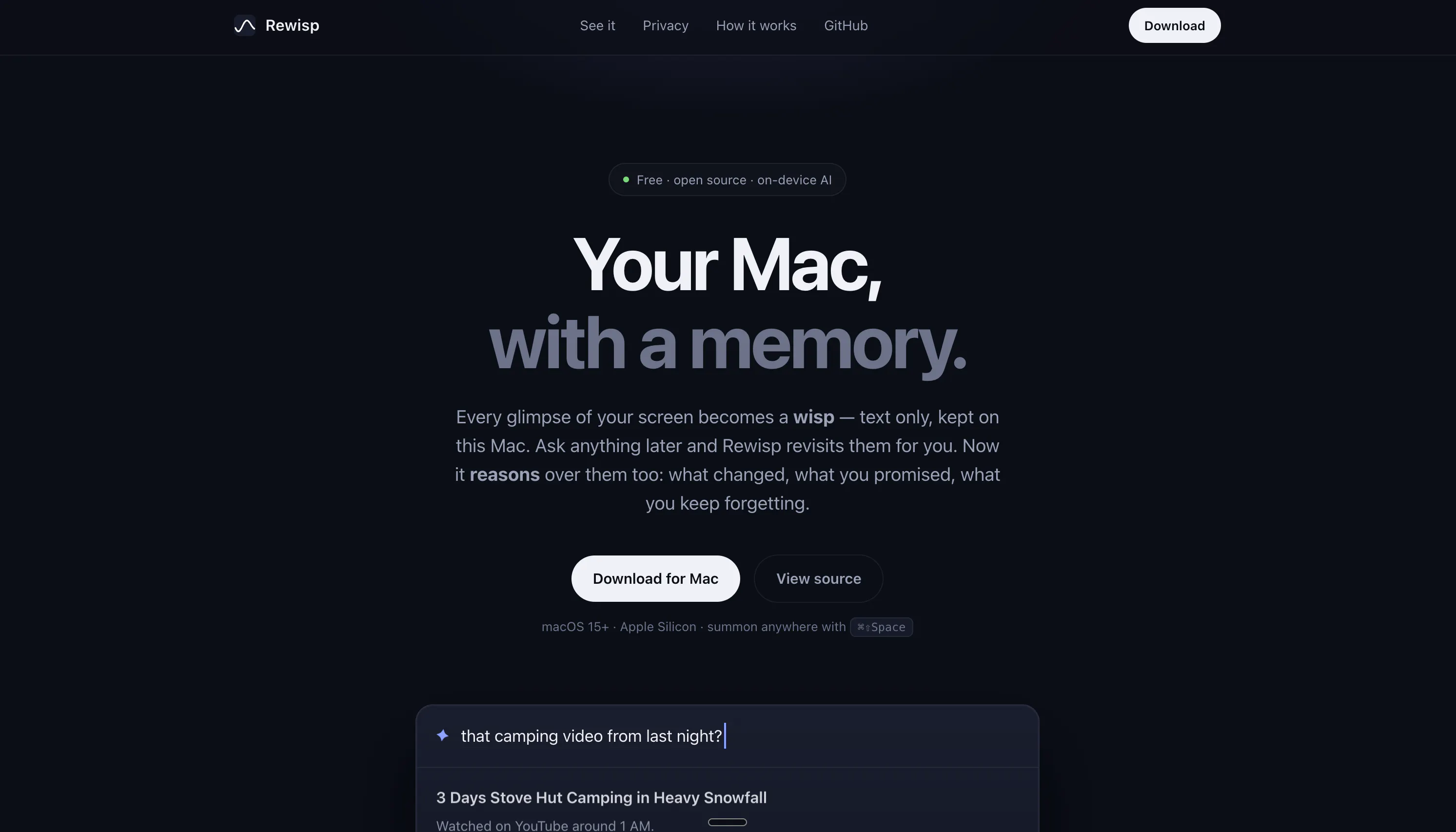 Rewisp came in fifth with 177 votes and 34 comments, and it may have been one of the more imaginative launches of the day. It describes itself as an ambient memory for your Mac, reading screen text on-device and remembering it for you. That turns a general productivity tool into something more specific and more memorable. The examples in the description are concrete: it catches promises like “I’ll send it Friday,” reminds you until they are done, summarizes what changed since Tuesday, searches by meaning instead of just words, and even helps fill forms from saved details without storing passwords.
The launch likely appealed because it mixes utility with a small amount of unease, which is exactly what a strong productivity pitch often does. Rewisp promises to remember the things people forget, while also reassuring them that screenshots are never saved and everything stays on the Mac. That privacy framing matters a lot for a product that watches the screen. With its modest but solid vote and comment counts, the launch suggests users were intrigued by the idea of ambient memory, even if they still want to understand how far that memory goes.
6Detourmap
 Detourmap took sixth place with 151 votes and 29 comments, and it offered a far more exploratory experience than the day’s productivity and AI tools. The product is a free interactive world map of places worth going out of your way for, spanning ruins, beaches, caves, waterfalls, volcanoes, monuments, sacred sites, castles, museums, gardens, theme parks, and ghost towns. Its positioning is refreshingly simple: pick a country, turn on filters, and browse. That clarity is probably why it works. There is no complicated workflow to understand, only the pleasure of discovering places you might otherwise miss.
The scale in the description is part of the appeal, since 70,520 places is a big number and immediately suggests depth. The product feels more like a discovery layer than a travel utility in the traditional sense, which may have helped it catch attention among users tired of generic travel recommendations. With 29 comments, it clearly sparked enough conversation to show people were imagining their own use cases. This is a good reminder that not every successful launch needs to solve a painful business problem; sometimes a well-framed curiosity engine is enough.
7Double
 Double finished seventh with 59 votes and 48 comments, which is a curious combination. The vote total is modest compared with the launches above it, but the comment count is relatively high, suggesting the product prompted discussion even if it did not convert that attention into broad approval. Double describes itself as an AI career agent that gets you hired, and the description goes all the way in: text it and it will find roles, apply for you, grow and maintain your network, and make recruiters chase after you.
That kind of promise is bold, and perhaps a little confrontational, which helps explain why people engaged with it. Career products often get comments because everyone has an opinion on job searching, automation, and what should or should not be delegated to software. The launch likely stood out because it targets a deeply emotional workflow and packages it as a concierge rather than a tool. Even so, the vote-to-comment balance suggests the audience was interested but still evaluating whether this level of automation feels useful, credible, or merely provocative.
8CitedSpy
 CitedSpy came in eighth with 60 votes and 39 comments, placing it just behind Double despite having nearly the same vote total. The product is built around a growing concern for brands: visibility inside AI search. It promises to track how often a company is mentioned, cited, and recommended across ChatGPT, Gemini, Claude, Perplexity, and other assistants, then identify citation gaps and benchmark competitors. That makes the positioning timely, especially for teams already thinking about Generative Engine Optimization as a new layer on top of traditional SEO.
What likely helped CitedSpy stand out is that it translates an abstract trend into a measurable workflow. Brands are increasingly asking not just whether they rank in search, but whether AI systems mention them at all. This product gives that worry a home. The 39 comments suggest the topic was debated, which makes sense because the category is still forming and people are sorting out what matters. A launch like this benefits from being early to a concern that many teams already suspect is important, even if the playbook is not fully settled.
9Wishlist and gifts – Farha
 Farha ranked ninth with 38 votes and 43 comments, one of the most comment-heavy launches relative to its vote count. That usually signals a product people found relatable, even if it did not surge in broad popularity. The app is pitched as a free wishlist tool for families, letting people create wishlists from any store, share them without sign-up, and coordinate gifts using secret reservations and group gifting. It is straightforward, but it solves a real social coordination problem that many households encounter repeatedly.
The launch angle here is less about technology and more about reducing friction around giving. The no-signup sharing is especially important because gifting workflows often break down when the process becomes too complicated for casual participants. The product’s modest ranking suggests it may not have had the broadest appeal of the day, but the comment count hints that people had opinions, likely because the use case is familiar and personal. In categories like this, polish and trust can matter more than scale, and Farha seems to have positioned itself around ease rather than novelty.
10Pelagic Analytics
 Pelagic Analytics closed out the top 10 with 39 votes and 23 comments, and it clearly aimed at the intersection of measurement and automation. The product describes itself as a Google Analytics alternative with an AI SEO agent built in, promising to show where customers come from and what drives conversion while also researching keywords, writing articles, and publishing them automatically. The pitch is ambitious, but it has a coherent throughline: analytics should not just report performance, it should help improve it.
Its cookieless, real-time positioning and promise to avoid the consent banner headache give it a familiar privacy-first angle, while the AI agent component pushes it into a more active category. The vote total is smaller than the leading analytics tools on the list, but the idea still feels aligned with a clear founder need: fewer disconnected tools, more automatic execution. Pelagic likely stood out because it combined a crowded category with a direct outcome story, even if the launch day audience was more selective in how much attention it gave it.
What founders can learn from this launch day
The clearest lesson from July 19 is that specificity still matters. The launches that rose highest did not just say they were better; they explained exactly what they replaced, what they automate, or what frustration they remove. OpenSEO did this by naming a familiar incumbent and pairing it with a lower price. Spycost did it by turning an everyday annoyance into a product. Kobbe and Pelagic did it by making analytics feel less abstract and more tied to revenue, privacy, or action. That kind of clarity is often the difference between a product people browse and one they actually discuss.
A second theme is that founders are increasingly leaning into products that help users make sense of complex systems, especially AI and the web around it. BaseRT, Rewisp, CitedSpy, and Double all point in different directions, but they share a common idea: software should not just show information, it should do more of the work. That is a powerful pitch when it is grounded in a real workflow, but it also raises the bar. The more ambitious the automation, the more important it becomes to explain the boundary of the product in plain language.
Finally, this launch day shows how much trust signals still shape adoption. Privacy language, open source framing, on-device processing, and simple pricing were not side notes; they were part of the main story. Founders often think the strongest launch is the most novel one, but Product Hunt users on days like this seem to reward the products that feel understandable, economical, and credible. If there is a practical takeaway, it is that a good launch does not need to be loud. It needs to make the first five seconds of the pitch feel obvious.
