
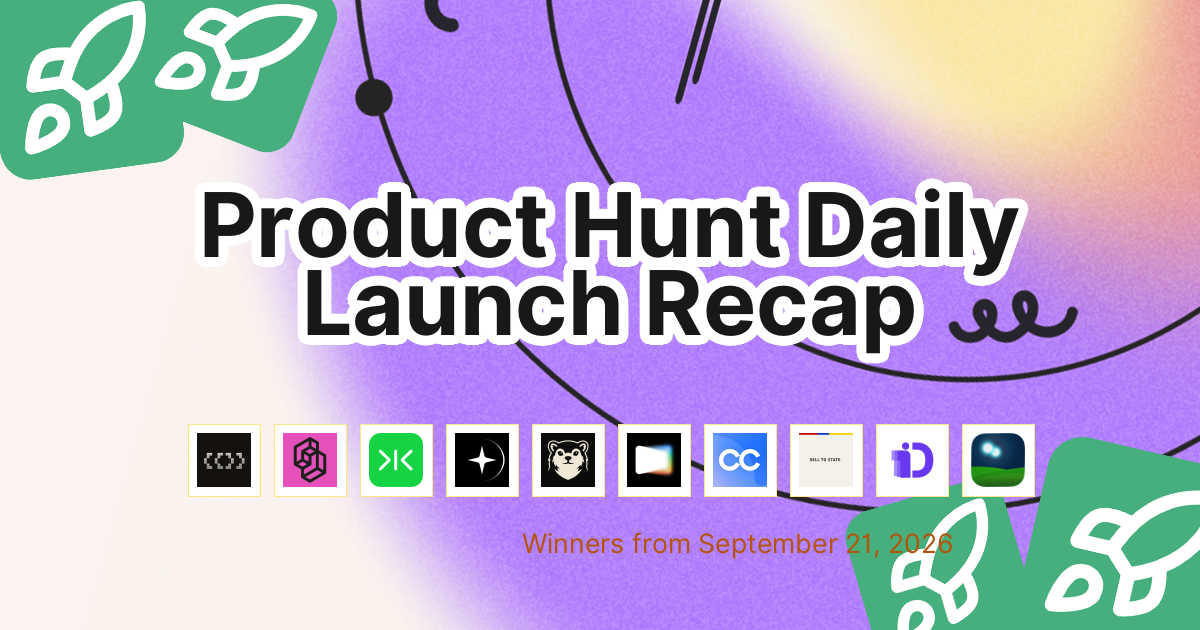
Product Hunt’s top launches on 2026-09-21 read like a snapshot of where founders think software is headed: closer to the work, closer to the device, and much more opinionated about what should be automated. The highest-ranked products were not just “AI tools” in the abstract. They were products that tried to sit directly inside a founder’s day, whether that meant shipping code from a phone, reviewing automation decisions, or letting software operate a computer like a human would.
What made this day interesting is how varied the execution was beneath that shared AI theme. Some launches leaned into infrastructure and control, others into convenience and cross-device continuity, and a few were aimed at very specific operational pain points that have historically been too messy for generic software to solve. The vote counts show clear curiosity around agentic workflows and runtime security, while the comment totals suggest that a handful of products also sparked actual conversation rather than passive approval.
1Superset Mobile
 Superset Mobile took the top spot with 481 votes and 126 comments, which already says something about the appetite for tools that make coding agents feel less tied to a desk. Its pitch is simple but ambitious: orchestration for coding agents from an iPhone, with the ability to pick up the same workspaces from a computer, review diffs, and merge pull requests while away from the keyboard. In practice, that positioning turns “mobile app” into more than a convenience layer. It becomes an operational extension of an existing agent workflow.
That framing likely helped it stand out because it solves a familiar founder problem in a very current way. People building with Claude Code, Codex, and other terminal agents do not just want generation. They want continuity. Superset Mobile appears to understand that the real friction is not whether an agent can code, but whether a founder or engineer can keep momentum when they are away from their machine. The fact that it is included with Superset Pro and offered with a first month free using MOBILELAUNCH also suggests a launch strategy built around fast trial and a clear upgrade path.
The combination of strong vote volume and substantial comment activity suggests this was more than a novelty launch. The community seems to have responded to the idea of treating phones as a place to supervise real engineering work, not just to get alerts. That makes Superset Mobile feel especially aligned with where the market is going: agentic systems that still need human judgment, but no longer require human presence at a desk.
2Jev
 Jev finished second with 488 votes, the highest vote total in the set, but only 13 comments, which is an interesting contrast on a day full of conversation about AI. TypeSafe AI is positioning Jev as a “System One” frontier model for fast, structured AI decisions rather than text generation. Instead of producing prose, it returns typed outputs like Choice, Score, and Noul answers with calibrated probabilities that software can act on directly. That is a very different product promise from the usual chatbot framing, and it reads more like a decision layer than a conversational assistant.
The product’s positioning is unusually technical, but also unusually concrete. The launch copy emphasizes speed, cost, and determinism: parallel sampling, roughly 70 to 500 millisecond responses, and claims of being materially faster and cheaper than comparable LLM workflows, with output tokens free. That kind of language likely appealed to builders who are tired of wrapping brittle prompt output in parser logic. If your software needs a machine-readable decision, a typed probabilistic response is easier to trust than a paragraph that must be reinterpreted after the fact.
Its vote count suggests the market is intrigued by this idea, even if the comments did not explode into a long discussion. That pattern often shows up when a product is technically compelling and immediately legible to engineers, but still niche enough that the broader audience is mostly reacting with interest rather than debate. Jev’s launch feels like one of the clearest examples on the day of AI moving down the stack, from content creation toward structured decision infrastructure.
3Sai
 Sai landed at rank 3 with 406 votes and 46 comments, and it earned attention by promising something that still sounds futuristic in product form: an autonomous computer fleet that handles screen work the way a human would. The product describes itself as a “robosecretary,” which is a memorable phrase even before you get to the mechanics. Rather than relying on APIs, Sai works by reading the screen, clicking buttons, and typing into forms, which means it can operate legacy desktop apps, internal portals, and other software that lives behind a login.
That positioning matters because it goes after the messiest category of automation. Plenty of products can integrate with modern SaaS tools. Far fewer can bridge the gap between software that was designed for humans and workflows that still need to happen at scale. Sai’s support for Windows, macOS, and Linux broadens the pitch further, and the reported 73% on OSWorld gives the launch a performance angle that helps it feel more than speculative.
The vote and comment mix suggests people saw this as both practical and provocative. A tool that can operate a computer like a human is exactly the kind of thing that sparks curiosity, but also skepticism about reliability and edge cases. That likely fueled the discussion without suppressing interest. Sai stood out because it was not asking the audience to imagine a new interface. It was asking them to imagine AI sitting down at the existing interface and doing the boring work no one wants to do.
4Arcjet
 Arcjet came in fourth with 383 votes and 77 comments, which is a strong signal for a product that does not try to dazzle with surface-level AI features. Instead, it focuses on securing the AI agents developers are already building. The pitch is about runtime protection: detecting prompt injection, authorizing tool calls, redacting sensitive data, and blocking bots and abuse before an action happens. In other words, Arcjet is selling guardrails at the moment they matter most.
That matters because agentic software changes the security conversation. Once models can decide, call tools, and move data around, the risk surface shifts from “what did the model say?” to “what did the model do?” Arcjet’s positioning suggests it understands that shift and wants to live inside the application rather than around it. It is less about scanning after the fact and more about enforcing policy in real time.
The comment volume is telling here. Security products often generate more discussion than their vote counts alone would suggest, because builders want to know how the system behaves under pressure and where the boundaries are. Arcjet likely stood out because it addresses a fear that is becoming more common as AI systems are given agency. If founders are going to ship agents into production, they need something that helps them trust the behavior of those agents, not just the quality of their outputs.
5Hyrax AI
 Hyrax AI ranked fifth with 221 votes and 13 comments, and it brought a different flavor of AI to the table. Rather than focusing on prompts or user-facing generation, it presents itself as an AI architect for an entire codebase. The promise is not merely to identify what is wrong in a pull request, but to find what should improve across the codebase as a whole, then do the work in context, verify it against tests and checks, and open a GitHub pull request for review.
That is a strong positioning move because it shifts code review from a reactive task to a proactive system. Most engineering tools are still scoped narrowly to the changes in front of them. Hyrax is trying to widen that lens to architecture and conventions across the repository, while also prioritizing issues across six engineering domains. That gives the product a sense of ambition that goes beyond linting or review automation.
The relatively modest comment count does not diminish the strength of the idea. If anything, it suggests a product that likely appealed most to technical teams who immediately recognized the value but did not necessarily need to debate the concept publicly. Hyrax’s stand-out quality is its end-to-end posture. It is not just pointing at code quality problems; it is attempting to close the loop and produce a merge-ready fix.
Google Flow for iOS & Android
Google Flow for iOS & Android ranked sixth with 176 votes and 9 comments, which is a respectable showing for a mobile release from a company with broad brand recognition. The product is framed as Google’s AI creative studio on mobile, bringing cinematic video, images, and tools to a phone. The most notable detail in the description is the emphasis on using your camera roll and live camera uploads to ground generations in personal experiences, along with cross-device project syncing so work follows you.
That positioning is smart because it narrows a huge category into something people can immediately understand. Mobile creative AI can easily become abstract, but anchoring it in the camera roll makes the product feel personal and practical. It suggests a workflow where inspiration is not something you have to recreate elsewhere; it is already on your phone, waiting to be turned into something else. That kind of framing likely helped the launch cut through the noise around general-purpose image and video generation.
The vote and comment pattern implies curiosity more than controversy. People probably know what to expect from a Google-branded AI creative tool, but the mobile angle and syncing story make it more relevant to everyday usage. It stands out because it treats the phone not as a secondary surface, but as the place where creative input already happens.
 CC came in seventh with 118 votes and just 2 comments, and the low comment total gives it the feel of a product people understood quickly. Google Labs is positioning CC as a shared AI agent for families and households, with up to six people able to choose what to share while CC helps keep everyone aligned on the day ahead. The key idea is not broad productivity but the small logistical tasks that usually disappear between inboxes and calendars.
That makes CC interesting because it applies the agent concept to a more domestic, less enterprise-oriented problem. There is no need for deep technical explanation here. The product’s value proposition is easy to grasp: coordination is hard, and families need something that helps reduce friction without requiring a new way of managing life. The limited comment activity may reflect that simplicity. People likely saw the concept and immediately filed it as a household assistant rather than a platform to argue about.
What likely helped CC stand out is the contrast between its modest tone and the broader AI noise surrounding it. A shared agent for families is not as flashy as autonomous coding or computer fleets, but it is a clear example of AI moving into everyday routines. That subtlety can be a strength on Product Hunt when the proposition is concrete and the target user is easy to picture.
8Sell to State
 Sell to State ranked eighth with 120 votes and 24 comments, and it is one of the most commercially direct launches in the top ten. The product offers search across 3 million government contracts in 64 countries, with structured procurement data spanning tenders, suppliers, and agencies. Its pitch is very specific about the job it solves: helping businesses research what governments buy and find new opportunities to sell to them.
The launch is also notable for how it lowers friction around a notoriously complex category. By promising free browsing and then a flat fee for the full dataset, saved searches, REST API, and MCP, it turns procurement intelligence into something more accessible to modern sales and data teams. The copy about not needing a foreign company or e-signature before deciding whether there is money to be made is especially pointed, because it addresses a real hesitation in global selling.
Its vote and comment profile suggests a product that found an audience because of its utility, not because it was wrapped in trendy language. That can be a powerful launch strategy when the dataset is the product. Sell to State stands out precisely because it is operational, not aspirational. It gives founders and go-to-market teams a new source of signal in a market that is often fragmented and hard to research.
9AI Creative Insights by Decode
 AI Creative Insights by Decode finished ninth with 110 votes and 12 comments, and it brought a highly practical lens to creative testing. Built by Entropik, the team behind Decode, the product predicts how people will respond to ads before media spend goes live. It accepts banners, OOH, video, and other creative, then returns attention heatmaps, second-by-second emotion curves, and prescriptive suggestions for what to change.
This is a strong example of AI being used to compress an expensive decision cycle. Rather than replacing the creative team, the product gives them a way to evaluate variants earlier and with more structure. The inclusion of category benchmarks and Synthetic Audience predictions suggests that the product wants to help teams compare performance not just against themselves, but against a broader market context. That makes the launch feel more like a decision support system than a pure prediction engine.
The vote count indicates healthy interest, while the comment count suggests enough substance to prompt questions without turning the launch into a debate. What likely helped it stand out is its specificity. It does not promise to make all creative better in some vague way. It promises to tell you which ad is more likely to work before you spend the budget, which is the kind of claim marketers can immediately evaluate.
10Turfs
 Turfs rounded out the top ten with 100 votes and 2 comments, and it is a useful reminder that not every strong launch has to be AI-native. The product is a Mac desktop organization tool that keeps content across your computer arranged in defined areas. A turf can be backed by a real folder, a Finder tag, or a hand-picked selection of files and folders, and the desktop stays put even through Show Desktop. When you quit, the desktop returns exactly as it was.
That level of specificity is what makes the product compelling. Mac desktop clutter is a universal annoyance, but Turfs goes beyond a generic organizer by replacing Finder’s own desktop icon layer. The launch copy also makes a point of the distribution choice: because of that replacement layer, it cannot be sandboxed or sold on the Mac App Store. It is priced at $29 once with a 10-day trial and no card required, which suggests a straightforward, product-led monetization model.
The low comment count does not suggest weakness; it may simply reflect the fact that the product solves a narrow but recognizable problem cleanly. Turfs stands out because it understands that desktop organization is not about ideology. It is about preserving the working state you actually want. For a lot of people, that is enough to make a utility worth paying attention to.
What founders can learn from this launch day
The biggest lesson from this launch day is that founders are not just chasing intelligence. They are chasing proximity. The strongest launches all moved closer to the moment of action: code on a phone, decisions in typed form, automation inside the computer itself, security at runtime, and creative review before spend. That pattern suggests a market that is less interested in abstract AI capability and more interested in products that collapse the distance between intent and execution.
Another clear signal is that specificity still wins. The launches that felt easiest to understand were the ones that named a concrete workflow and a concrete outcome. Government procurement search, desktop organization, family coordination, and creative pre-testing all work because the user can imagine the daily pain immediately. Even the more technical products benefited from sharp framing. Jev was not “an AI model.” It was a structured decision engine. Arcjet was not “security for AI.” It was security at runtime before an action happens.
Finally, the comment and vote patterns show that Product Hunt audiences still respond to products that imply a shift in behavior, not just a feature upgrade. The day’s biggest attention came from launches that asked a familiar question in a new way: what if the phone became your control center, what if the model returned a decision instead of text, what if the computer itself became the interface for automation, and what if security lived inside the agent loop? Those are the kinds of ideas that make founders pause, because they point to where software habits may be changing next.
