
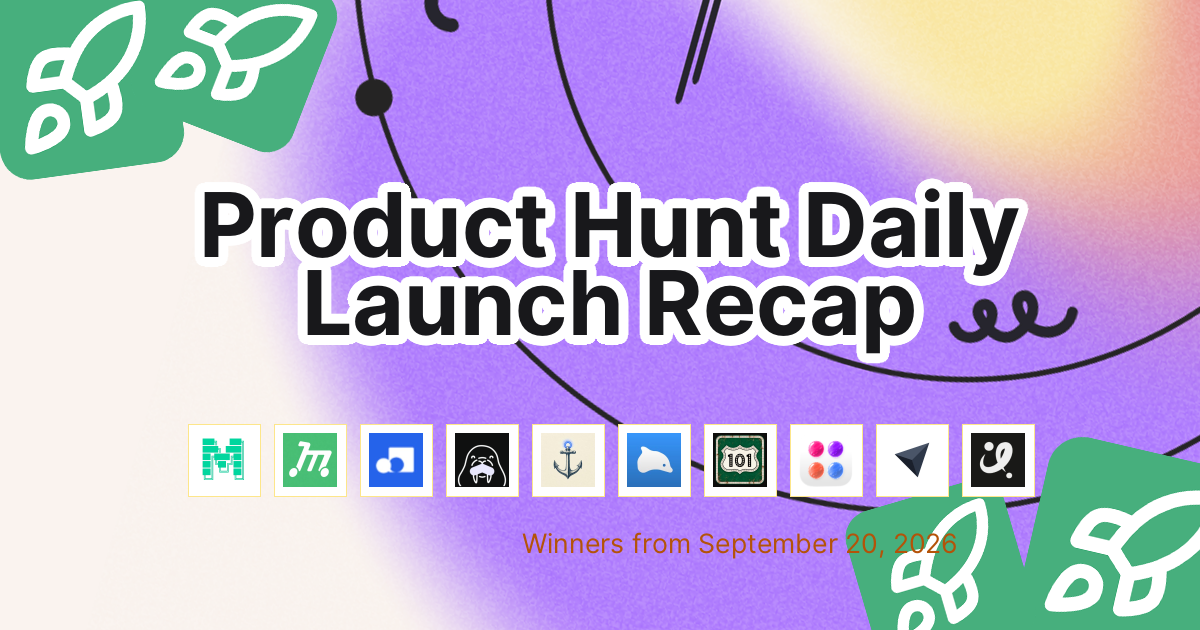
This Product Hunt day had a clear pattern: founders were not trying to invent entirely new categories so much as they were attacking familiar pain with sharper workflows, tighter positioning, and a stronger promise of control. The top of the board was led by Mycel, which framed itself as infrastructure for service businesses rather than another generic automation layer, but the rest of the day was just as revealing. AI showed up everywhere, yet most of the launches succeeded by narrowing the problem instead of broadening it.
That made the day feel more practical than flashy. Several products leaned on trust, continuity, and reversibility: Harbor promised predictable pricing, Termphin promised an SSH session that would not disappear on you, and Epismo promised your work would survive switching AI tools. Even the more playful entries were precise about the job they were doing. If you are building in 2026, there is a useful lesson here already: people are still happy to vote for ambitious software, but they seem to respond best when the product removes a specific source of friction and says exactly how.
1Mycel
 Mycel took the top spot on the day with 330 votes and 48 comments, and that combination says a lot about the kind of product it is. The launch did not present itself as a general-purpose automation platform. Instead, it was positioned as the operating layer for service businesses, running the work they already sell: clients, deliverables, approvals, and invoices. That framing matters because it turns the product into a business backbone rather than a tool that sits off to the side.
The most compelling part of the pitch is the way Mycel talks about safety and control. Each job runs in a disposable sandbox that never holds a credential, and nothing goes to a client until a human approves it. That is a clear answer to a fear many founders and operators have about automation: not whether it can do the work, but whether it can do the work without creating hidden risk. The mention of self-hosting free, alongside a $299 per month starting price, also suggests the team is speaking to buyers who care about sovereignty as much as convenience.
Its result indicates that Product Hunt voters were receptive to a product that feels operationally serious. A launch with that many votes and comments usually has more going on than novelty. Mycel likely stood out because it describes a real, recurring workflow and backs it with a concrete trust model. In a day crowded with AI promises, that kind of specificity reads as mature.
2Minicart
 Minicart came in second with 227 votes and 29 comments, and it did so by making ecommerce feel less like software to learn and more like a team you can talk to. The product is aimed at makers, creators, and resellers who want to launch an online store without mastering a conventional ecommerce stack. Its positioning is straightforward: get a store, then let AI handle the repetitive work around it.
The team metaphor is doing a lot of work here. Sloane manages the storefront, Milo handles marketing, and Logan takes care of logistics and customer replies. That naming makes the product feel approachable, but the underlying promise is practical: add products, update inventory, create promotions, ship orders, and manage customer interactions by chatting in plain language. Instead of forcing users to think in dashboards and workflows, Minicart tries to collapse store management into conversation and review.
The votes suggest that this framing connected well with people who know how hard ecommerce operations can become once a store is live. The comments count was not huge, which often happens when a product is easy to understand at a glance. What likely helped Minicart stand out was its crisp promise to remove setup friction while still leaving the human in the loop. It is not trying to replace the entrepreneur; it is trying to reduce the operational drag around them.
3Answers by Context.dev
 Answers by Context.dev finished third with 197 votes, but only 3 comments, which is a familiar pattern for a product aimed at builders who care more about utility than chatter. Its core idea is clean: give it a research task and the JSON shape you want back, and it will return structured data with source URLs. That is a strong pitch because it avoids the vague language many AI research tools fall into.
The product positions itself as a way to turn web research into a single API call. Rather than asking developers to stitch together search, scraping, and LLM calls on their own, Answers promises the assembled result. That makes it especially relevant for teams building enrichment pipelines, comparison tools, or research agents, where structure and sources matter more than a conversational summary.
The modest comment count does not imply weak interest; it more likely reflects a technical audience that immediately understands the use case and moves on. What probably helped Answers stand out was its precision. It knows exactly what pain it solves and exactly how it solves it. In a product day full of broad AI language, that kind of crisp developer-facing message is often what earns a vote.
4Morsa Signals
 Morsa Signals landed fourth with 168 votes and 14 comments, and it feels built for founders who have already discovered that distribution is now partly an AI-search problem. The product is aimed at developer-tool founders and GTM teams, combining GTM and SEO or GEO workflows in one place. Rather than offering another generic analytics layer, it promises workflows that start from the actual product and lead to an actionable result.
Its positioning is especially interesting because it spans both audience identification and search visibility. Users can find relevant developers for outreach, identify potential first users and early adopters, audit how AI search systems understand their site, and get a read on competitors worth tracking. That breadth could have looked unfocused in another context, but here it reads as a set of adjacent problems that modern technical companies genuinely have to solve together.
The vote and comment pattern suggests a launch that resonated with people living in the overlap between technical product and modern go-to-market work. That audience tends to reward tools that are immediately applicable and avoid report-heavy fluff. Morsa Signals likely stood out because it offers a practical answer to a problem many teams are feeling but still struggle to define cleanly: how do you get discovered, understood, and prioritized when both search and buyer behavior are shifting?
5Harbor
 Harbor ranked fifth with 150 votes and 3 comments, and it took a very different route from most of the day’s AI-heavy launches. Its positioning is not about novelty but about trust. Harbor calls itself the Evernote alternative that puts its price in writing, which is a memorable way to speak to buyers who have been burned by shifting plans, lock-in, or vague pricing before they commit to a long-term notes app.
The product itself is broad in the way a serious personal knowledge tool should be: notes, scans, PDFs, and recordings, all searchable with OCR and handwriting support. One-step Evernote import lowers the switching cost, while native apps across Mac, Windows, iPhone, iPad, Android, web, and CLI signal that this is meant to be durable infrastructure rather than a single-device utility. The full export on every plan reinforces the same point. This is a product trying to win by being dependable over time.
The vote total shows that there is still appetite for a well-positioned productivity app if the promise is sharp enough. Harbor likely stood out because it makes its value proposition unusually legible. Price locked for three years, then capped after that, is the sort of detail people remember. In a day of products promising intelligence, Harbor succeeded by promising predictability.
6Termphin
 Termphin came in sixth with 123 votes and 5 comments, and it solved a pain that every developer understands immediately once they have had it: SSH sessions that die at exactly the wrong time. The product promises SSH that survives a locked phone, lost signal, or a switch to mobile data. That is a very specific benefit, and specificity is exactly what makes the launch easy to grasp.
The interesting technical detail is the small agent that keeps the shell open on the server and returns you to the same screen. That framing makes the product feel like an engineering solution to a real mobility problem rather than a cosmetic terminal app. The inclusion of htop and vim rendering properly, plus SFTP, keys, snippets, and tunnels, tells you the maker is speaking to people who live in terminals and know where the pain comes from.
The comment count is modest, but for a niche developer tool that is not unusual. What likely helped Termphin stand out was the immediate universality of the problem. Anyone who works from a laptop and phone, moves through unstable networks, or hates losing a remote shell can picture the value instantly. The product does not ask for abstract belief; it describes a failure mode and removes it.
7The 101 Plays Itself
 The 101 Plays Itself was seventh with 105 votes and just 1 comment, and it brought a different kind of energy to the day. The product turns a live Caltrans traffic camera on the US-101 in Studio City into music in the browser. Every car that crosses the line plays a note, which means the piece is always changing because the road is always changing.
As a launch, it is more experience than software utility, but it is still very clearly a product with a concept. The framing is wonderfully concrete: real traffic on the southbound 101, this minute, rendered as sound in real time. That directness probably helped it more than any elaborate explanation could have. You understand it in one sentence, then you want to see whether the idea actually works.
The limited comment count suggests people may have experienced it as a delightful curiosity rather than a long discussion prompt. That is not a weakness. Products like this often perform by being memorable, not by generating debate. It stood out because it transformed a familiar public scene into something playful and immediate, which is a rare move on a day dominated by serious productivity and AI tooling.
8Launchie 1.6.1
 Launchie ranked eighth with 104 votes and 1 comment, and it spoke directly to a very specific kind of Mac user frustration. Apple removed Launchpad in macOS 26 and kept it out of 27, and Launchie steps into that gap with a simple promise: bring the grid back. The product is not trying to reinvent app launching from first principles. It is trying to restore a workflow people already liked.
The feature set follows that restoration logic. Users can arrange apps their own way, create unlimited folders, use Spaces for separate app pages, and search instantly. The free tier plus one-time Pro purchase will also have appealed to people tired of ongoing subscriptions for simple utility software. Mentioning both the Mac App Store and Homebrew widens the distribution story without making the product feel bloated.
The vote count suggests steady interest from a niche audience that values control and familiarity. Launchie likely stood out because its pitch is grounded in a very current platform change. When a large vendor removes a feature people relied on, a tool like this does not need to invent demand. It just needs to show that it understands the workflow and can bring it back in a cleaner form.
9ManyPI
 ManyPI took ninth place with 99 votes and 7 comments, and it aimed squarely at revenue teams that want more than a contact list. The product starts with a defined ideal customer profile, finds those people on the live web, verifies their email, validates pain points and emotional buying triggers, and then sends hyper-personalized outreach. That is a dense promise, but it is also coherent. The whole pitch is about converting signal into sales.
There is a clear throughline here: identification, verification, validation, and outreach are all part of the same motion. That matters because many outbound tools stop at lead generation or enrichment and leave the rest to the user. ManyPI is trying to package the full motion into one system, which likely explains why it drew interest despite being in a crowded category.
The comment count was enough to show some engagement without turning into a heated debate, which is often what you see when a launch is concrete but not polarizing. The thing that probably helped ManyPI cut through was its promise to work from behavior and pain, not just demographics. Founders and sales teams understand that ideal customers are not lists; they are patterns. This product is selling itself as the thing that finds those patterns and acts on them.
10Epismo OS
 Epismo OS closed the top ten with 93 votes and 5 comments, and it fits neatly into the day’s broader theme of continuity. The product keeps a team’s AI work in a Case, preserving the result, the decisions behind it, reviews, and the next step. That gives it a strong identity: it is not just about generating output, but about keeping the work attached to the reasoning that produced it.
Its positioning is especially relevant for teams that switch between AI tools or teammates. Rather than re-briefing from scratch each time, Epismo aims to carry the context forward. The auto review feature adds another layer, re-checking a saved result, flagging issues, and leaving the original unchanged. That suggests the team understands one of the biggest operational problems in AI work: outputs are cheap, but continuity is hard.
The modest vote total does not diminish the idea. In a category with a lot of noise, Epismo is trying to own memory and review, which are more durable problems than prompt generation itself. It likely stood out because it speaks to an emerging team behavior that is becoming more common: AI is now part of the workflow, but the workflow still needs a home.
What founders can learn from this launch day
The clearest lesson from this launch day is that precision wins attention. The strongest products did not try to explain everything they could do. They named one high-friction problem and made the value obvious. Mycel focused on service-business operations, Termphin focused on session continuity, Harbor focused on pricing trust, and Launchie focused on bringing back a missing Mac workflow. That clarity made each product easier to understand and easier to vote for.
A second takeaway is that founders seem to be getting better at selling control, not just capability. Several launches framed their products around human approval, exportability, locked pricing, or preserved context. That is telling. Buyers are not only asking what AI can automate; they are asking where the risk sits, what happens when something breaks, and whether they can leave if they need to. Products that answered those questions directly appeared to have an advantage.
There is also a strong pattern around practical AI. The day was full of AI language, but the launches that felt most grounded used AI as a mechanism, not the headline. Minicart used it to run an ecommerce store, Answers by Context.dev used it to structure research, and Epismo used it to preserve team work. That is a useful reminder for anyone launching in this space: the market is not looking for AI in the abstract. It is looking for workflows that feel more durable, more specific, and easier to trust.
If you are planning a launch of your own, this day suggests that the best story is rarely “we do everything.” It is usually “we remove this one painful step, and here is why you can believe us.” That was the common thread running through the top ten, and it is probably why this launch day felt more grounded than noisy.
