
Product Hunt’s July 31 lineup had a strong practical streak. The day was led by tools that help teams create, verify, observe, or understand what is happening inside their systems, with a few bigger AI bets mixed in for contrast. That combination usually says something useful about where builders are spending time: not just on generating more output, but on making the output easier to trust, deploy, and operationalize.
What makes a launch day like this worth studying is that the highest-ranked products were not all chasing the same buyer or the same problem. Some were aimed squarely at go-to-market teams, some at internal ops, some at developers, and some at the broader anxiety around AI misuse. The vote totals and comment activity suggest that usefulness alone was not enough; the products that rose highest were the ones with a crisp framing, an obvious pain point, and a story that made the product feel immediately legible to a Product Hunt audience.
1MiniMax H3
 MiniMax H3 took the top spot with 362 votes and 11 comments, which is a strong signal for a product that sits at the intersection of generative media and practical production work. Its positioning was straightforward but ambitious: unified video generation for motion design and branding, with an open multimodal model that can generate 2K video and native stereo sound. That kind of framing matters on Product Hunt because it gives both creatives and technical buyers a reason to stop scrolling.
The description does a lot of work here. By emphasizing text rendering, visual packaging, and complex instruction following, the launch positions itself less like a novelty demo and more like a commercial content engine. The fact that it supports text, image, and audio inputs suggests a broad workflow rather than a single one-off output, which likely helped it stand out in a category where many tools still feel fragmented. A #1 finish on a crowded day with relatively low comment volume also hints that people understood the pitch quickly and voted based on the promise of immediate utility.
2Cleanlist AI
 Cleanlist AI came in at rank 2 with 295 votes and 28 comments, one of the stronger comment counts on the board. That mix usually points to a launch that speaks directly to an existing workflow pain, and this one does exactly that. It is a natural-language prospecting tool built to find, enrich, and sync leads, and its positioning is practical from the first sentence: any prospecting input becomes a verified, enriched, CRM-ready lead list.
What makes Cleanlist AI feel especially product-market aware is how many messy entry points it accepts. CSVs, LinkedIn or Sales Navigator URLs, domains, and search filters all feed into the same output. The launch also highlights a 15-provider enrichment waterfall, AI research columns, and one-click CRM sync, which suggests the team knows GTM operators are tired of stitching together multiple tools just to get one list into usable shape. Its vote total shows broad appeal, while the comment count suggests enough people saw the operational value to ask questions or compare it with their current stack.
3mectrics
 At rank 3 with 271 votes and 21 comments, mectrics is a good reminder that not every successful Product Hunt launch needs to be dramatic. This one is a free, open-source Mac utility that puts your machine’s vitals in the menu bar, covering CPU, memory, battery, network, disk, GPU, temperature, and fans. The positioning is especially clean because it promises compact visibility without turning the menu bar into a cluttered dashboard.
The launch leans into control and restraint. Users can choose which metrics appear, and a click opens deeper detail when needed. The “Compact Health” idea is a smart product naming choice because it turns a list of system stats into a single, calm status indicator. That kind of simplicity tends to resonate with technical users who appreciate tools that stay out of the way until something goes wrong. The open-source and MIT angle likely helped too, since a lot of Product Hunt users respond well to useful infrastructure-adjacent utilities that are easy to trust and adopt.
4Poth Labs
 Poth Labs landed at rank 4 with 215 votes and 14 comments, and its pitch is more strategic than tactical. It calls itself “the customer brain for your company,” but the real message is that customer knowledge should be treated as a living network rather than a pile of documents. That is a strong positioning move because it reframes the product from a search layer into a reasoning layer.
The launch description makes clear that Ask Poth is designed to answer questions no single source can answer, such as what drives churn or why customers adopt or abandon features. It also matters that every conclusion is grounded in evidence, and that missing information can trigger adaptive surveys. That creates a fuller story than a typical knowledge base product: Poth is not only surfacing what a company already knows, it is also trying to close gaps automatically. The vote count suggests healthy interest in that vision, while the comments imply the audience was engaged enough to consider how this kind of system could fit into existing customer research or support workflows.
5DepthData
 DepthData ranked 5th with 173 votes and 24 comments, which is a useful signal because the product is aimed at a problem that has become much more common very quickly. Companies are now paying for multiple AI tools across their teams, but many still cannot answer basic questions about spend, usage, or seat efficiency. DepthData enters as the system of record for that spend, and the positioning is sharp because it treats AI procurement as a governance issue, not just a finance line item.
The launch stands out for its emphasis on trust. It says every number is labeled by how it is verified, that prompts are never read, and that the product exposes exactly what each vendor API can and cannot reveal. That kind of transparency is likely why it generated so many comments relative to votes: buyers probably wanted to understand how the data model works, what can actually be measured, and where the blind spots are. In a category where many tools promise visibility but are fuzzy about methodology, that clarity likely did a lot of the work.
6Halo by Scam AI
 Halo by Scam AI took rank 6 with 168 votes and 30 comments, making it one of the most-discussed launches of the day. The product is easy to understand immediately: it secures Zoom, Teams, or Google Meet calls live and flags synthetic faces the moment it detects one, all on device. That kind of pitch is built for urgency, and on Product Hunt urgency often drives engagement because people know exactly why the product exists.
The positioning is anchored in a real fear rather than an abstract technical capability. The launch description points to deepfake video calls being used for scams and emphasizes practical use cases like hiring and wiring money. That gives Halo a very concrete value proposition: don’t guess who you are talking to. The comment count is especially interesting here, because products in security and identity verification often invite debate about accuracy, false positives, and deployment constraints. Even so, the vote total suggests the idea of on-device detection for live calls landed with enough force to make the product one of the day’s more visible launches.
7witr
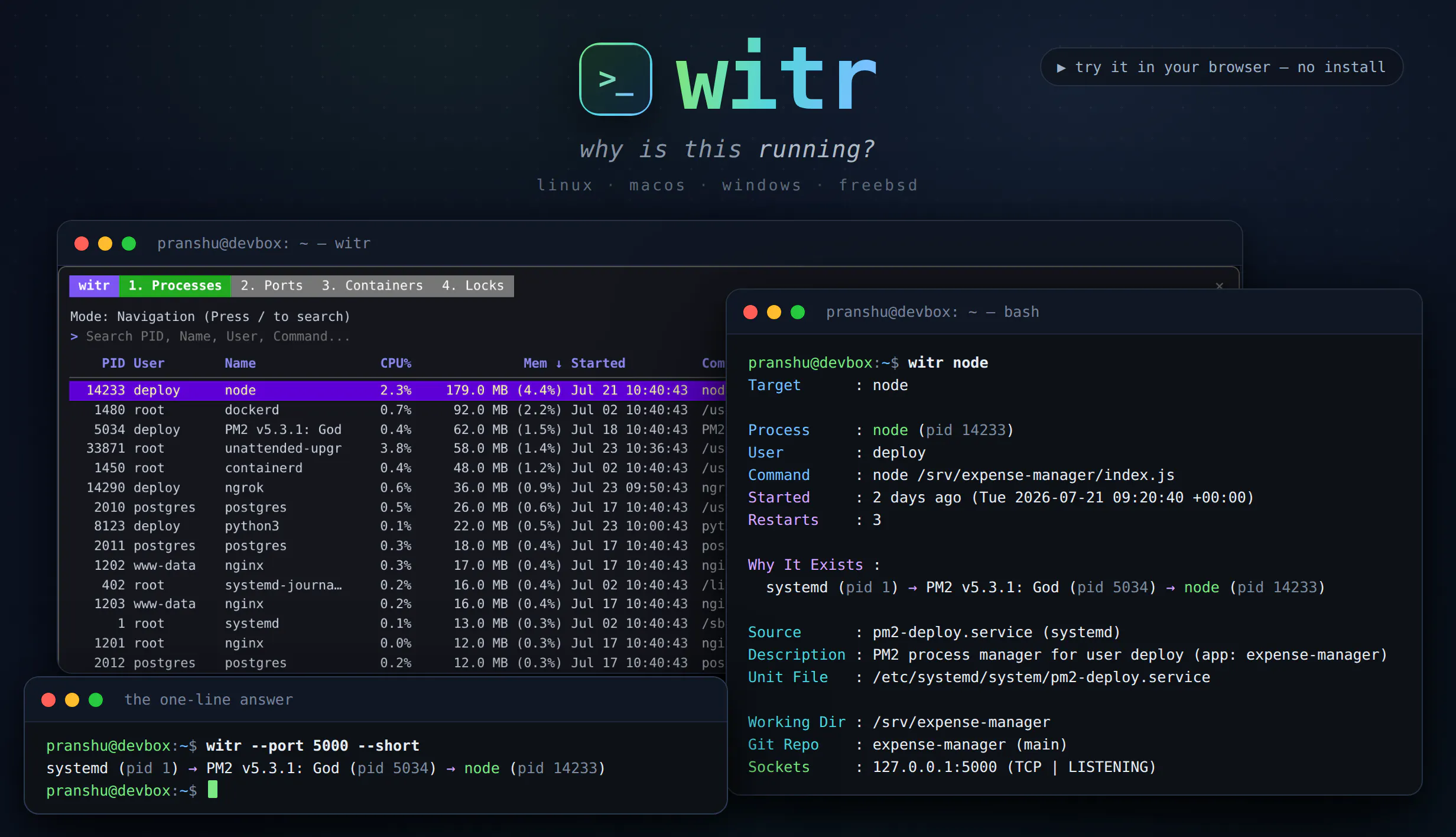 witr came in at rank 7 with 149 votes and 33 comments, which is the highest comment count among the top 10. That usually means a product hit a nerve with a technical audience, and this one clearly did. The premise is simple but useful: instead of only telling you what is running, it tells you why it is running. It traces the chain behind a process, PID, port, container, or file and shows where it came from, who started it, and when.
This is the kind of utility that becomes more compelling the more operational complexity a team has. By supporting both an interactive TUI and scripted output, witr is trying to serve humans and automation at the same time, and the one static Go binary across Linux, macOS, Windows, and BSD makes the deployment story very clean. The comments volume suggests people likely saw immediate debugging value in it, perhaps because process tracing is one of those problems that every engineer recognizes and few tools solve in a friendly way.
8Customer.io Summer Release
 Customer.io’s Summer Release ranked 8th with 143 votes and just 3 comments, which is a very different engagement pattern from the more conversational products above. That makes sense for a mature platform release. Rather than introducing a single new product, the company is presenting a broad expansion of ways to reach customers in the moments that matter, spanning geofencing, Live Notifications, flexible SMS providers, a notification inbox, improved WhatsApp management, smarter AI, and more.
The positioning here is about breadth and completeness. For an established customer engagement platform, that can be an effective Product Hunt story because it shows momentum and ambition, but it can also be harder to generate discussion unless there is one sharply novel feature to debate. The low comment count suggests the audience likely recognized the brand and the relevance, but did not feel a strong need to dig into details on the page. Still, 143 votes is respectable for a release this wide, and Colin Nederkoorn’s maker presence may have helped lend it additional credibility.
9Screencap
 Screencap landed at rank 9 with 137 votes and 21 comments. Its pitch is unusual in a way that makes it memorable: record how work actually happens, then turn those traces into structured datasets for automation and AI training. That is a compelling angle because it speaks to a very specific pain inside teams building automation systems, where documentation rarely reflects reality and manual data collection is slow.
The product also makes an effort to address the obvious concerns around privacy and consent. Sensitive apps are blocked before anything is written, and traces are scrubbed and reviewed before leaving a machine. That matters because products that record behavior can easily trigger skepticism, so the launch is doing more than describing functionality; it is trying to reassure buyers about how the tool operates. The open-source macOS angle likely helped it connect with technical users, and the vote-comment mix suggests people were intrigued by the workflow-to-dataset premise even if they needed a little more explanation than usual.
10Gemini Robotics 2
 Gemini Robotics 2 closed the top 10 with 124 votes and 2 comments. That is a modest engagement level for a product with a very large-sounding name, but the launch itself is clearly aimed at a different kind of audience than most of the day. It frames Google DeepMind’s latest step toward intelligent robots that can understand, reason, and act in the physical world, with whole-body intelligence, dexterous manipulation, and adaptive reasoning across different robot shapes and sizes.
This kind of launch usually does not compete on immediate utility the way a SaaS tool does. Instead, it competes on vision and credibility. The low comment count suggests that many voters may have treated it as a major signal piece rather than a product they were planning to evaluate and buy immediately. Even so, its presence in the top 10 shows that Product Hunt audiences still respond to ambitious frontier AI work, especially when it is framed as concrete progress toward robots that can collaborate with humans. In a day full of tools for making software and operations more legible, Gemini Robotics 2 offered the longest-range bet of the bunch.
What founders can learn from this launch day
One of the clearest lessons from July 31 is that specificity still wins. The top launches did not try to be everything to everyone. MiniMax H3 did not simply announce “video AI.” Cleanlist AI did not say “sales tool.” witr did not say “developer utility.” Each product used a crisp framing statement that pointed to a job, a workflow, or a fear that users already understood. On Product Hunt, that kind of immediate comprehension is often the difference between a product that gets glanced at and one that gets voted up.
Another pattern worth noticing is how much trust language mattered. DepthData emphasized verification. Halo stressed on-device detection. Screencap made privacy and consent central to the pitch. Even mectrics and witr, which are more straightforward utilities, benefited from being easy to trust because they are open source or single-binary tools. Founders often focus on feature breadth, but this launch day suggests that confidence in how a product works can be just as important as the feature set itself.
The comment counts also tell a story. The launches with the most discussion were the ones that invited questions about implementation, accuracy, or fit: witr, Halo, DepthData, Cleanlist AI, and Screencap. That suggests Product Hunt audiences are not only rewarding novelty; they are reacting to products that feel operationally relevant and slightly opinionated. If you are launching, the goal is not merely to explain what your product does. It is to make people see the shape of the problem so clearly that they want to talk back.
Finally, this day showed a healthy mix of near-term utility and longer-term ambition. Some launches help teams prospect, monitor machines, or manage AI spend today. Others point toward the next generation of content generation, robotics, or synthetic media detection. That balance matters because it reminds founders that Product Hunt is not one market. It is a collection of overlapping audiences, and the launches that perform best are usually the ones that know exactly which audience they are speaking to, and why that audience should care right now.
