

Today’s Product Hunt front page had a clear throughline: founders kept returning to the same question, but from different angles. How much of our work should stay local, private, and under our control, and how much should be handed to models, clouds, and automated systems? The answer showed up in everything from a personal context library and a private meeting notetaker to a hybrid AI compute system and a desktop writing assistant that sits inside your own machine.
That made for a launch day that felt practical rather than flashy. The highest-ranked products were not simply promising more AI; they were promising better boundaries around AI. The strongest launches also tended to be opinionated about workflow. They did one thing cleanly, defined the trust model up front, and gave buyers a simple reason to care. For founders, that is a useful signal in itself: clarity about where the product runs, what it stores, and what it refuses to do can be just as compelling as raw capability.
1Resurf
 Resurf took the top spot with 280 votes and 24 comments, which tells you immediately that it struck a chord beyond a small niche. The product positions itself as a personal context library for Mac, iPhone, and iPad, built for the things you care about, work on, and want to remember later. It accepts notes, links, images, PDFs, and ideas, then lets you retrieve them yourself or pass that context to AI through MCP and CLI.
What makes that positioning interesting is that Resurf does not frame context as a vague productivity promise. It frames it as infrastructure for memory, both human and machine. The emphasis on local storage and private iCloud sync is likely part of why it resonated. In a day crowded with AI products, a tool that explicitly says your context stays yours has a very different emotional appeal than another app asking for broad access to everything.
The vote count suggests strong early curiosity, while the comment total hints that people were engaging with the product as a serious workflow bet rather than a novelty. It likely stood out because it solves a problem founders and power users feel constantly: the gap between collecting information and actually being able to use it when it matters. Resurf’s pitch is not about organizing content for the sake of neatness. It is about making personal knowledge usable in the age of agents.
2Perplexity Hybrid Compute
 Perplexity Hybrid Compute landed in second with 226 votes and just 3 comments, which is a telling combination for a launch from a well-known product. The idea is simple enough to explain quickly: cloud for research, Mac for privacy. Their Mac app splits a task between the cloud and the user’s own machine, letting the strongest AI handle reasoning and research while anything involving private files stays local on the Mac.
That division of labor is probably the whole story here. The product positions itself not as a general-purpose assistant, but as a smarter architecture for tasks that cross the line between public and private data. The requirements also narrow the audience in a deliberate way, since it works on Apple silicon with a 24GB RAM minimum and is live for Pro, Max, and Enterprise users. That specificity makes the product feel engineered rather than marketed.
The high vote count with very few comments suggests the launch was easy for people to understand and maybe even easier to endorse than to debate. It likely stood out because it resolves a tension many AI users already feel: cloud models are powerful, but local privacy matters. Perplexity turned that tension into a product feature instead of treating it as a compromise.
3Cognition’s SWE-2

Cognition’s SWE-2 came in third with 183 votes and 3 comments, and the launch was built almost entirely on a cost-to-performance argument. The model is described as Cognition’s new coding model, post-trained from Kimi K3 with RL that optimizes for both cost and capability. The headline claim is concrete: it reaches 50.0% on FrontierCode 1.1 Main, within a point of Fable 5.1 at 64% less cost, and only a few points behind GPT-6 Astra at a quarter of the cost.
This is a very founder-friendly way to position a model launch. Instead of simply claiming it is smarter, the pitch makes the buying decision legible in operational terms. It also anchors the product in Devin Desktop and CLI, which makes the model feel immediately useful rather than abstract. In other words, it is not just a benchmark release; it is a tool meant to live inside real developer workflows.
The relatively low comment count compared with the vote total suggests that the launch’s appeal was mostly in the numbers and the practical takeaway. It likely stood out because founders and technical buyers are increasingly sensitive to unit economics in AI. A model that advertises fewer turns, lower cost, and better scores speaks directly to that pressure.
4ScreenCursor
 ScreenCursor finished fourth with 185 votes and 16 comments, which is a stronger conversation rate than some of the launches above it. The product is a screen recorder with auto zoom effects, designed so that every click, drag, and keystroke becomes a zoom. The promise is a finished video with the camera moves already in place, no editing required, and nothing leaving the user’s computer.
That combination of convenience and privacy is a good example of how many launch-day winners are being framed now. ScreenCursor is essentially trying to remove post-production from the demo recording process, while also reassuring users that the content stays local. The result is a product that feels tailored to anyone making tutorials, internal demos, or founder-led walkthroughs and tired of spending time polishing recordings afterward.
The comment count likely reflects that people immediately understood the use case. A lot of screen-recording tools ask users to learn editing habits or accept a generic output. ScreenCursor’s value proposition is much sharper: record once, get a polished motion path for free, and keep everything on-device. That clarity probably helped it punch above what might otherwise be a modestly narrow category.
5Visiby
 Visiby ranked fifth with 134 votes and 13 comments, and it is one of the day’s most timely products. It helps brands measure and improve their visibility across AI search platforms like ChatGPT, Perplexity, Gemini, and Google AI Overviews. Rather than focusing on classic SEO alone, it tracks mentions, recommendations, and citations inside AI-generated answers and shows where competitors are winning.
That positioning tells you exactly who the product is for and why it exists now. As AI search becomes part of the discovery path, brands want to know whether they are present at all, let alone favorably represented. Visiby turns that uncertainty into a measurable workflow. It is less about content creation than about perception management in a channel that still feels new to many teams.
The vote and comment mix suggests a healthy level of interest without the kind of broad emotional reaction that some consumer tools get. That makes sense: this is a serious B2B problem, and the appeal comes from relevance rather than delight. Visiby likely stood out because it addresses a question a lot of marketers and founders are starting to ask in private, even if they have not yet built a formal process around it.
6Clipwise
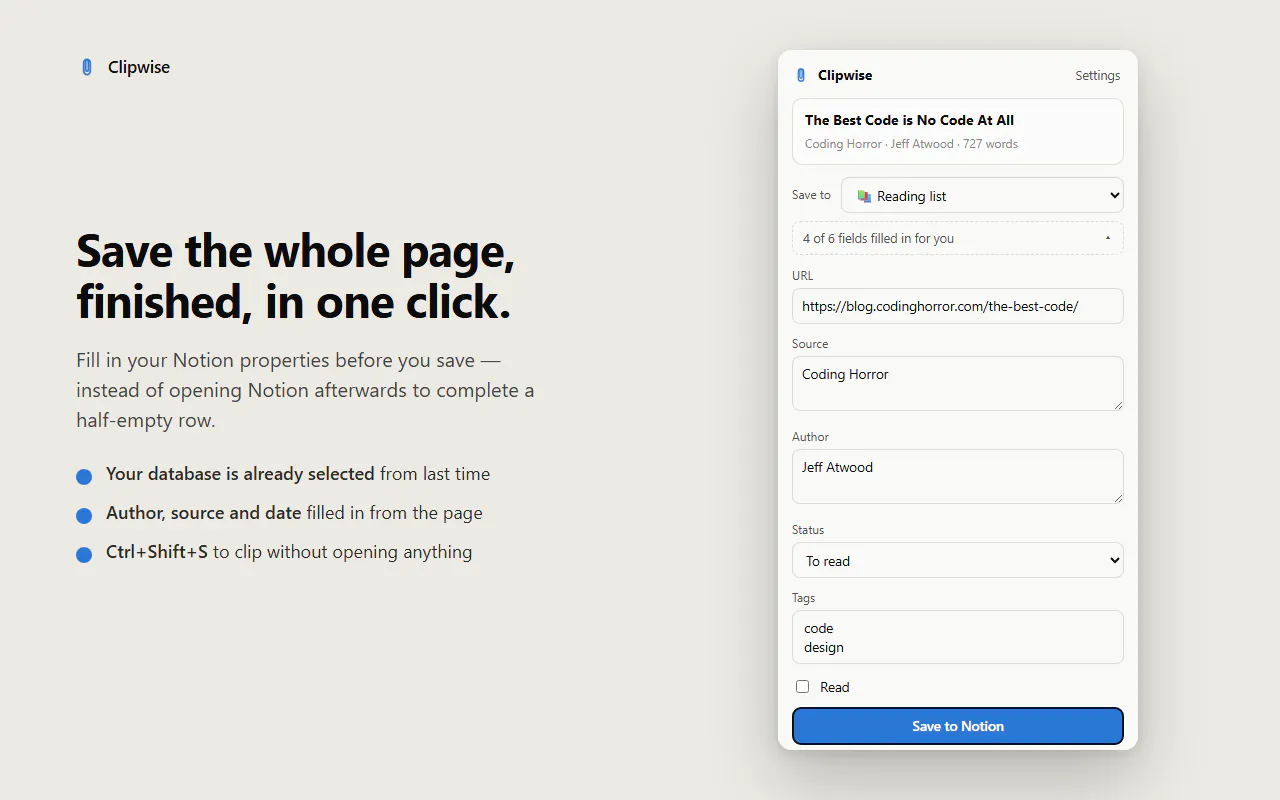 Clipwise took sixth place with 127 votes and 8 comments. It is a web clipper for Notion that promises to save any web page to your databases without cutting the article in half. The launch message is unusually direct: no account, no login, no paywall, and it lets you fill in your database properties before saving while remembering the last one you used.
The product sits in a familiar category, but the positioning is careful and practical. Notion users often accept clunky capture flows because the destination is so valuable. Clipwise tries to remove that friction by keeping everything on the user’s computer and avoiding the common annoyances that make clipping feel like a chore. That makes the product feel less like a plugin and more like a small but meaningful workflow upgrade.
The vote count shows enough demand to validate the problem, while the comments suggest users were likely evaluating whether it really improves on existing capture habits. It probably stood out because it solves a very specific annoyance with a familiar destination. Products like this often perform well when they respect the user’s existing system instead of trying to replace it.
7DemoTV
 DemoTV ranked seventh with 113 votes and 4 comments, and it had one of the more unusual formats on the board. The product is a 24/7 channel of product demos ranked by the people watching. Makers can submit a short demo for free, viewers watch head-to-head Channel Battles, and an Elo-style score determines which demos sit on Channels 1-3. Businesses can also buy clearly labeled airtime, but money only buys exposure and clicks, not ranking.
That model is clever because it reframes product discovery as programming rather than listings. It also tries to protect trust by separating paid placement from audience ranking. For founders, that matters. A product like this has to make a strong case that distribution can be useful without becoming pay-to-win, and the wording suggests the maker understood that tension from the start.
The relatively modest vote and comment totals may reflect the fact that the concept is still novel and takes a moment to absorb. But novelty can be part of the appeal. DemoTV likely stood out because it offers a new surface for product demos at a time when most launch channels still look the same. Whether the idea scales is a separate question; as a launch, it was memorable in a way that a standard promo page would not have been.
8SHIUI
 SHIUI came in eighth with 111 votes and 4 comments. It is an ink-style web UI kit inspired by Hinomaru Japanese posters, with a design language built around paper, sumi, vermilion, and zero shadows. That description is short, but it tells the story of the product completely: this is a visual system with a very specific mood.
Unlike many launches on the day, SHIUI is not trying to solve an operational problem. It is selling taste, identity, and aesthetic direction. That can be harder to quantify, but it is often easier to understand. The sharpness of the visual concept likely helped it stand out among more utility-focused products because it gives designers and founders an immediate mental picture of the finished experience.
The vote total suggests decent interest for a design kit, while the comment count implies that people were probably responding more with appreciation than debate. Products like this tend to perform when they are distinctive enough to be recognizable at a glance. SHIUI’s strength is that it commits fully to a style instead of diluting it.
9GhostWriter by MyHandler
 GhostWriter by MyHandler placed ninth with 113 votes and 18 comments, which is a good sign that it sparked conversation. The product is a desktop writing assistant for Windows that can be triggered with a double-tap of Left Ctrl in any text field. It draws on the thread on screen, the user’s calendar, files, and past meetings stored in an encrypted vault on the PC, then writes a reply that matches the user’s style and stops before sending.
That is a strong and very specific positioning. Rather than being a general writing tool, GhostWriter is focused on replying in context without asking the user to copy-paste information between systems. The promise that it never sends the message is also important because it frames the product as an assistant, not an autonomous agent. For a lot of professionals, that boundary is exactly what makes a tool feel safe enough to try.
The comment count suggests the launch prompted real discussion, likely because the use case is both powerful and slightly provocative. A product that reads your context, learns your tone, and drafts replies in any app invites questions about privacy, trust, and control. Those are not drawbacks in this case; they are part of the product’s identity, and they probably helped it rise above simpler AI writing tools.
10Epilude Notetaker
 Epilude Notetaker closed the top 10 with 108 votes and 9 comments. It records meetings on a Mac without a bot joining the call, then writes a transcript, summary, and action items. The notes save as Markdown files that the user owns, which gives the product a clean, durable output format instead of trapping the value inside a proprietary dashboard.
The product is clearly aimed at people who want private meeting capture without the awkwardness or visibility of a bot in the meeting itself. That design choice likely matters more than it first appears. Many teams are increasingly aware of how their notes are stored and shared, and Epilude meets that concern with a simple promise: keep the notes local, make them useful, and leave the file in a format people can actually keep.
The vote count is respectable for a utility product, and the comments suggest there was enough interest to signal real buyer intent. It probably stood out because it solves a familiar pain point with a restrained approach. No bot, no lock-in, no complicated story. Just private notes that belong to the user.
What founders can learn from this launch day
The clearest lesson from today is that privacy is no longer a niche selling point. It showed up as a core feature in products about context libraries, hybrid AI compute, screen recording, writing assistance, and meeting notes. Founders do not need to wrap every product in a privacy message, but they should be prepared to explain where data lives, what stays local, and why that choice matters.
A second pattern is that specificity wins. The launches that felt strongest were not the broadest. They were the ones that knew exactly which workflow they were improving and exactly what tradeoff they were making. Resurf is about personal context. ScreenCursor is about no-edit screen capture. Clipwise is about saving web pages into Notion cleanly. GhostWriter is about drafting replies inside the apps people already use. That kind of focus makes a product easier to understand and easier to champion.
Finally, this launch day shows that AI products are maturing into infrastructure products. The winning pitch is less often “we use AI” and more often “here is the boundary between the model and your data, and here is the job it now does better.” For founders, that means the story has to include trust, workflow, and output format, not just capability. When those pieces line up, the product is easier to adopt and easier to explain.
